World Day of Social Communications
In every human face, God has imprinted “a reflection of divine love, so that we may fully live our humanity through love” [1], thus begins Pope Leo XIV’s message to communicators on this World Day of Social Communications.
Since 1967, a papal message has been issued for this day. Previously, each message was addressed to journalists and professionals who create content for the media, but this year the Pope extends it to those who wield power through the media and to those responsible for AI, warning everyone of the danger of disregarding the human person by manipulating faces and voices: “We are not a species composed of predefined biochemical formulas. Each of us possesses an irreplaceable and inimitable vocation, that originates from our own lived experience and becomes manifest through interaction with others” (Pope Leo XIV) [2].
Human identity is at stake
This topic has been the subject of several Vatican publications, serving as a call to each of us to educate ourselves toward true freedom in deciding how to use technology, bearing in mind that the unethical application of all possibilities for technological intervention in various spheres of human life has led to superhumanism and posthumanism, as we read in the recent document Quo vadis humanitas [3]:
“What is at stake is the question of human identity, individual and collective, in a developing world, in the light of vocation in Christ” (n.19).
The message makes clear that the Church is in favor of technological development, carried out ethically and with respect for human individuality: “The challenge, therefore, is not technological, but anthropological. Safeguarding faces and voices ultimately means safeguarding ourselves. Embracing the opportunities offered by digital technology and artificial intelligence with courage, determination and discernment does not mean turning a blind eye to critical issues, complexities and risks” (Leo XIV) [4].
The digital space is missionary territory
It is incredible how technology, while facilitating so many encounters, also carries the danger of misunderstandings, whether due to the formation of closed-minded groups (extremism), individualism, or the dismissal of others. The digital space is missionary territory. “The question is no longer whether to engage with the digital world, but how. Social media in particular is an environment where people interact, share experiences, and cultivate relationships unlike ever before. At the same time, however, as communication is increasingly influenced by artificial intelligence, there arises the need to rediscover the human encounter at its very core” [5].
The power of the Personal Ideal
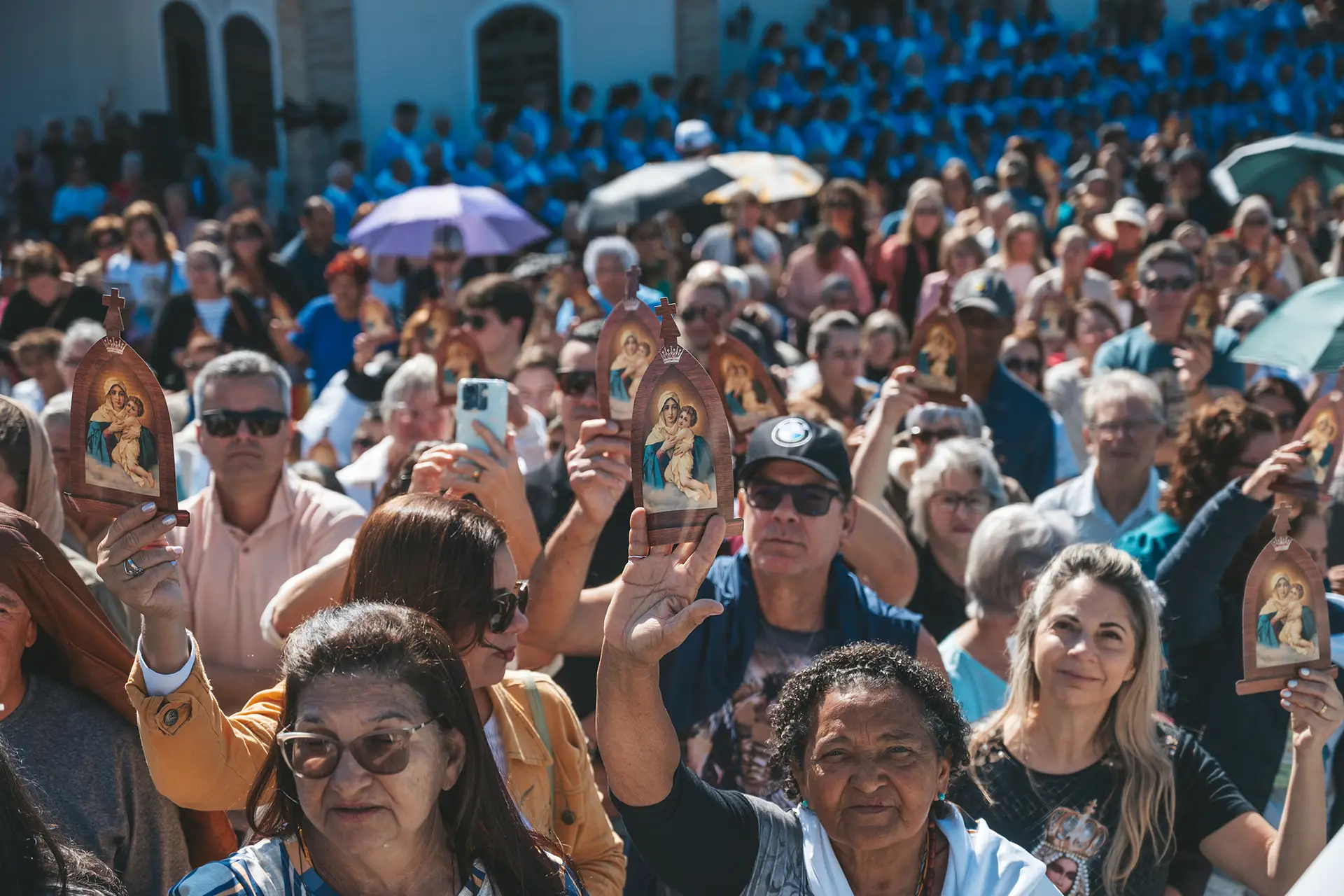
Pope Leo XIV points out some paths to protect human identity: responsibility, cooperation, and education. Each person must give the best of themselves, respect the identity of others, and avoid becoming just another digital algorithm. Our Schoenstatt contribution follows two paths: the cultivation of the personal ideal and the commitment to making Mary present, through the graces she offers in the Shrine.
Our missionary action in the digital space must be conscious both in method and in message. To this end, the first thing we must do is get to know ourselves well and educate ourselves as free personalities. As our Father and Founder, Fr. Joseph Kentenich, says: “God has given me a very original way of being; He formed me to fulfill a clearly defined mission. All that remains for me is to observe how unique my tendencies and the movements of grace are… we do not want to abandon our identity, the imprint of nature, proper to our being and our actions. We cannot measure others by our own standards, nor can we be a copy, a mere imitation of a model; rather, each of us must maintain our full originality” [6].
Bringing Mary’s tenderness to digital dwellers
As conscientious people, we strive to make the digital space a true place of encounter, as much as possible, by maintaining personal connections on our social media and offering others the gift God has given us: the Blessed Mother, in her Shrine.
“The digital environment needs missionaries who lead people to Mary, so that, with her tenderness, she may help ensure that connections are accompanied by a true encounter and bond. May her maternal heart become a sanctuary of welcoming and transformation for those who live closed off within themselves, in need of loving and being loved. It is not communication strategies that guarantee the beauty, goodness, and truth of communication. These must be imbued with tenderness.” [7]
In this way, we are digital inhabitants and missionaries who are aware that, by living the Covenant of Love, we protect and promote faces and voices in their human authenticity, as reflections of divine love.
Read the full message here:
Translation: Maribel Acaron
References:
[1] Pope Leo XIV. Message. 60th World Day of Social Communications. 2026 – https://www.vatican.va/content/leo-xiv/en/messages/communications/documents/20260124-messaggio-comunicazioni-sociali.html
[2] Ibid.
[3] International Theological Commission. Quo vadis, humanitas? Thinking through christian anthropology in the face of certain scenarios for the future of humanity – https://www.vatican.va/roman_curia/congregations/cfaith/cti_documents/rc_cti_doc_20260304_quo-vadis-humanits_en.html
[4] Pope Leo XIV. Message. 60th World Day of Social Communications. 2026
[5] Dicastery for Communication. Towards Full Presence – A Pastoral Reflection on Engagement with Social Media. https://www.vatican.va/roman_curia/dpc/documents/20230528_dpc-verso-piena-presenza_en.html
[6] Book: Myself, an Adventure: Guide to the Personal Ideal (print, Brazilian edition)
[7] Book: The Vocation of the Catholic Communicator, Sr. M. Nilza P. da Silva, 2025, Ed. Santuário and Paulinas.