Today, May 8, marks one year since the world came to a standstill and television screens in hundreds of countries focused on a single window in Rome. There was enormous anticipation to discover the man who would succeed none other than Pope Francis. Surprise, excitement, and curiosity gripped all those who saw Robert Francis Prevost, Pope Leo XIV, appear on a balcony surrounded by people from every continent.
A year later, it is now possible to outline the paths the Holy Spirit is showing us through his pontificate. The word “peace” takes on greater relevance with each passing month.
To reflect on this first year of his pontificate, we spoke with some schoenstatters living in places that are significant in the Pope’s life. They share their impressions and what they have discovered throughout this first year of challenges and blessings.
Pope Francis’s Man
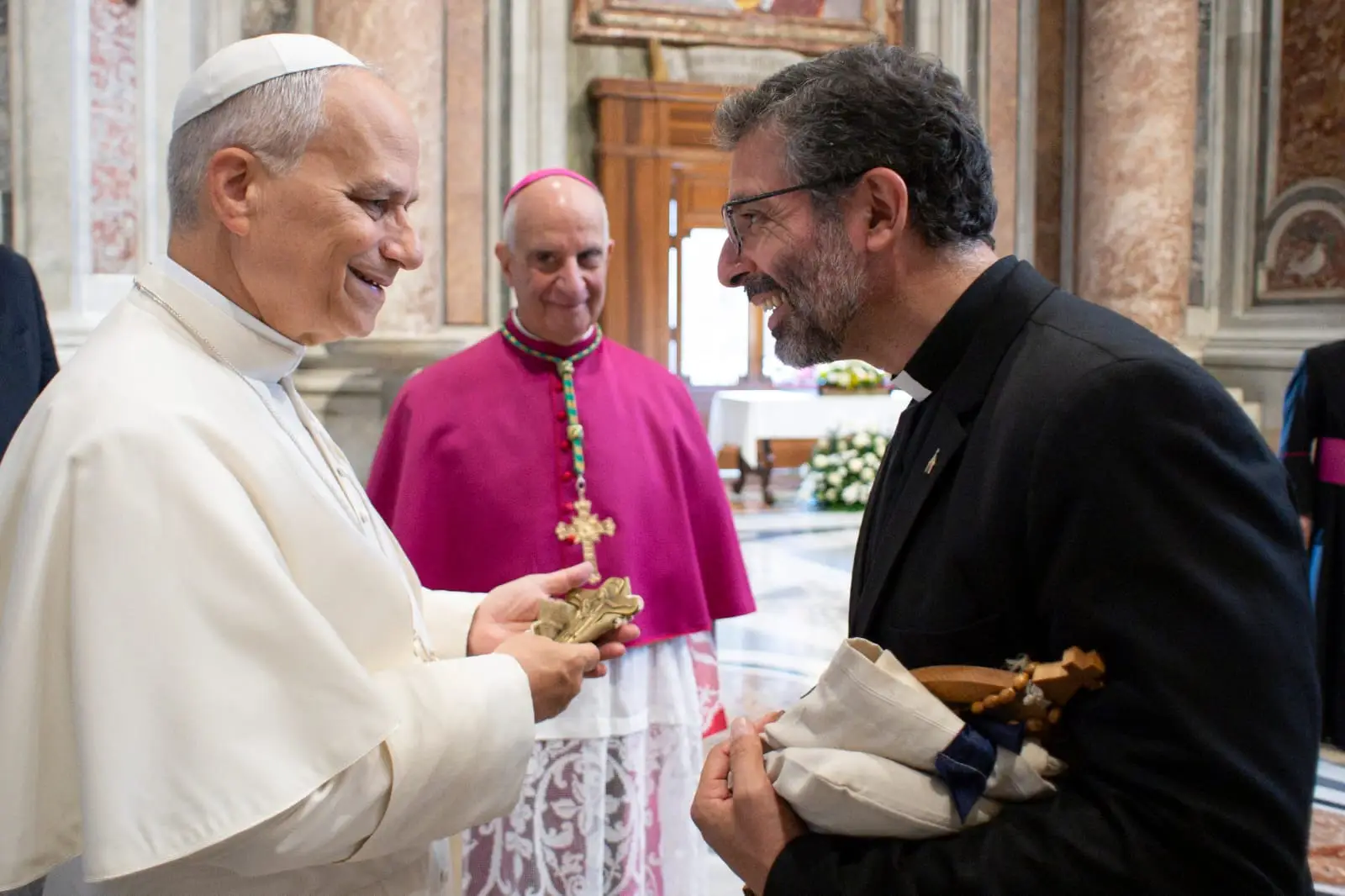
The director of the Schoenstatt Movement in Italy, Fr. Pablo Pérez, has already met personally with the Pope and shares his impressions of this first year:
God guides history: that of each person and that of all humanity. He is the Lord of history. Through the Incarnation, He entered history and through His Spirit He remains with us, guiding and leading us from within.
Every era gets the Pope it needs. God is faithful and never makes a mistake. Furthermore, I would venture to say that, in recent decades, God has spoken very eloquently through our universal shepherds.
It has been a year since that afternoon when Leo XIV appeared and said to us, “La pace sia con voi.” Words that are increasingly prophetic and relevant. We still need that peace as a gift from God.
A year has passed, and slowly Leo is showing us who he is and where the Spirit wants to lead the Church of Jesus Christ. He is clearly one of Francis’ men. Francis first made him a bishop and then appointed him prefect of the Dicastery for Bishops. And yet, more than one of Francis’ men, Robert Francis Prevost is a man of God. He values and cherishes Francis’ legacy, yet he has also dared to take other decisions. This speaks to his authenticity and independence of spirit.
Humanly speaking, he has an advantage: when he was elected, he had already been living in Rome for several years. This has likely given him a greater understanding of the ecclesial context in which he now exercises his ministry.
He is a man who not only calls for peace but also conveys it. He shares the direction and vision of Francis’s Church. He allows himself to be carried along by this momentum. However, his methods are not the same as Francis’. And that is as it should be. In this Church that goes forth and engages in dialogue with the world, it seems we need some time to mature and consolidate synodally certain themes prophetically raised by Francis, but with a different sensibility to complement the legacy, so that in communion we may continue to grow as a Church at the service of humanity.
The “Peruvian” Pope
Mrs. Carmita Cely, a missionary with the Pilgrim Mother Apostolate and a member of the Schoenstatt Mothers’ Branch in Chiclayo, Peru, met Pope Leo XIV in her diocese. A year after the pontiff’s election, she comments:
Peru is a blessed country to have as the supreme representative of the Catholic Church a great shepherd, a model of humility, love, and deep faith.
His Holiness Pope Leo XIV, the Peruvian, fills us with pride and strengthens our commitment to the Church. Always identified with Peru and Chiclayo, we are happy and lift up our prayers for his pastoral mission.
May the Lord enlighten, guide, and lead him on his path; may the Virgin Mary cover him with her mantle and embrace him in her heart.
*In the photo, Carmita is standing to the Pope’s right in Chiclayo

In Chicago, we heard testimonies from his close friends
Guadalupe Castillo lives with her family in Chicago, Pope Leo’s hometown. She, who is part of the Schoenstatt Family League, shares her impressions and what she has discovered in this first year:
“Habemus Papam”—what an exciting phrase. How beautiful to experience that moment, to keep intact in our memory the place, the setting, the people who were with us, in that moment so full of joy when our Mother Church gives us a Father.
For us Schoenstatters, the word “Father” has a profound meaning, and this is how we feel: we are blessed because we have learned to see reflections of God the Father to whom we can entrust ourselves as children.
On May 8, the day of the papal election, I was in Argentina, at my parents’ home. Seconds before Pope Leo appeared on the balcony, I lifted my 3-month-old daughter into my arms, looked at her, and smiling, said, “Belén, we’re going to meet YOUR Pope.” What a surprise when they announced that our Pope is Robert Prevost, from Chicago. Our home for two years and the birthplace of Belén.
Eager to get to know him better and as citizens of Chicago, we were delighted to watch two documentaries about his life published by Vatican Media: “León of Peru” (June 2025), and “Leo from Chicago” (Nov 2025). That is how we came to know our father, Pope Leo. We saw him in rain boots in the mud, walking among the people, in his community of Chiclayo, attentive to the material and spiritual needs of every family. And we also heard the testimonies of his close friends from his hometown. Gradually, we are getting to know a Pope who we also feel knows us, who has walked our paths, and who knows how to listen with his heart.
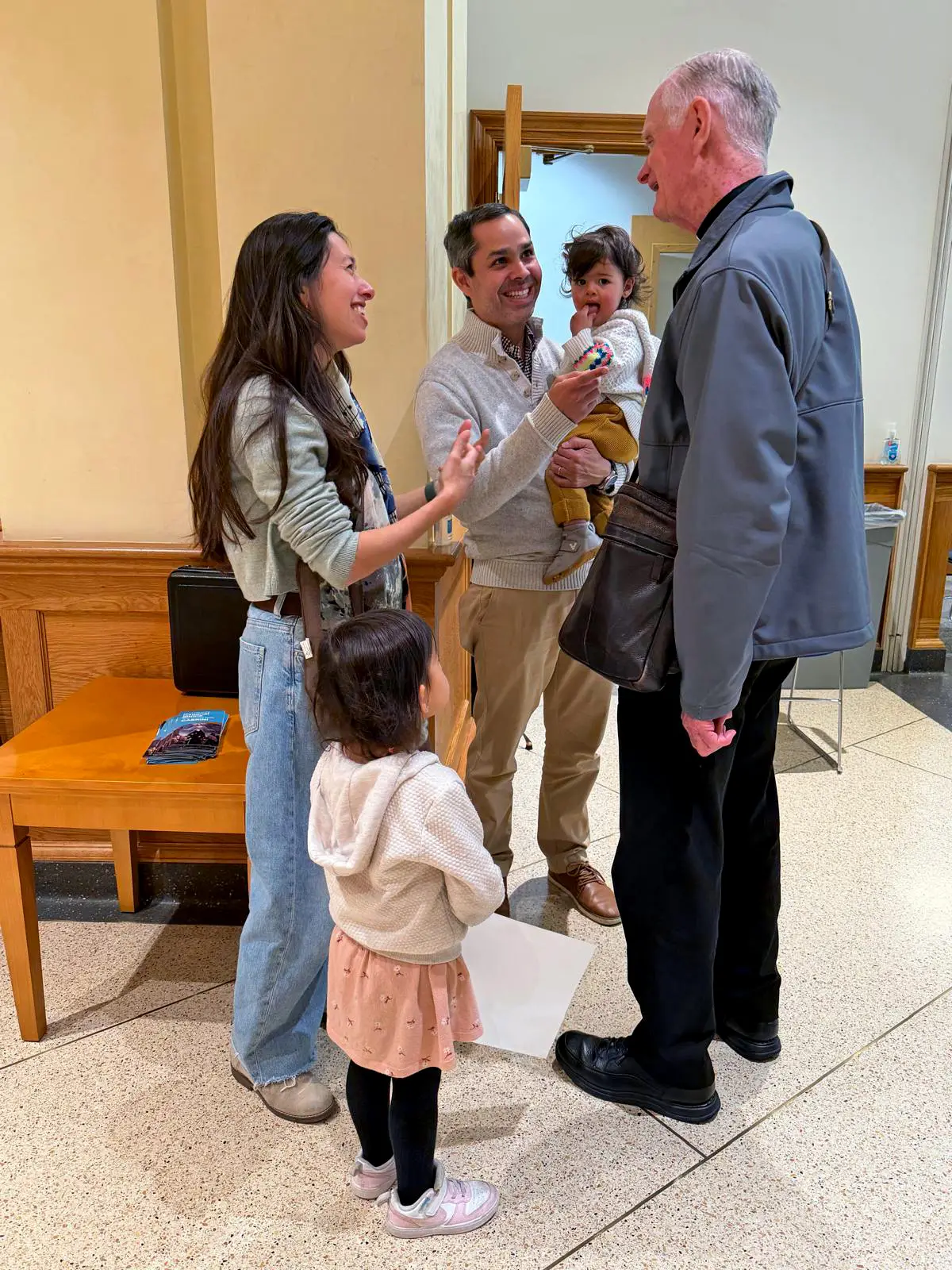
And while we also had the joy of visiting Rome and attending an audience with Pope Leo, the day we felt closest to him was last Sunday at the National Shrine of Saint Frances Cabrini (patron saint of immigrants), located here in Chicago. There we were able to speak informally with Bishop Daniel Turley, O.S.A., rector of the Shrine, who joyfully shared with us photos from his recent meeting with Pope Leo and told us about some of their experiences together.
Bishop Turley has a clear and radiant look, his hands radiate love, and his presence makes you feel at peace and filled with joy. He lived in Peru and was Father Prevost’s superior. His humility prevents him from using these words, but we could sense that he has been a spiritual father to our Pope. And in meeting Bishop Turley, we were able to experience that love, closeness, and warmth that the documentary about the Pope manages to convey.
So, reflecting on this encounter, a gift from Providence, once again I take to my heart the words of Cardinal Prevost when he presented himself to the world as Pope Leo: “I am a son of Augustine, an Augustinian.”
One year into his pontificate, I am glad to be able to affirm that we have a father who has been a son and who knows himself to be a beloved son of God.
Translation: Maribel Acaron