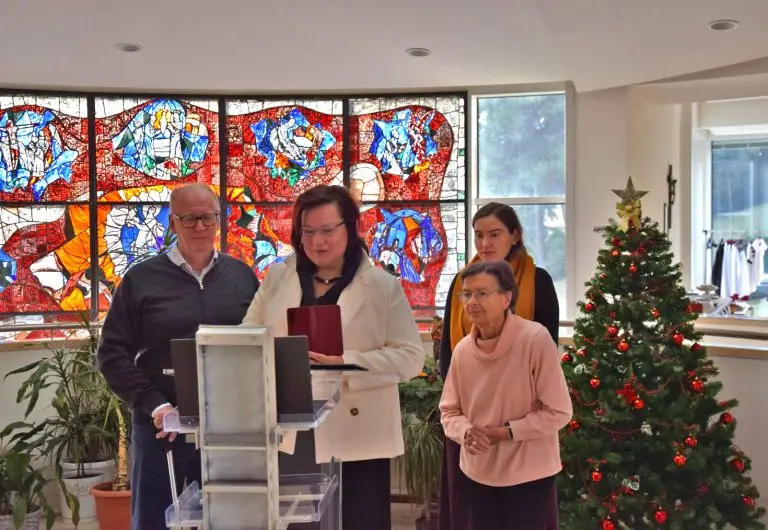
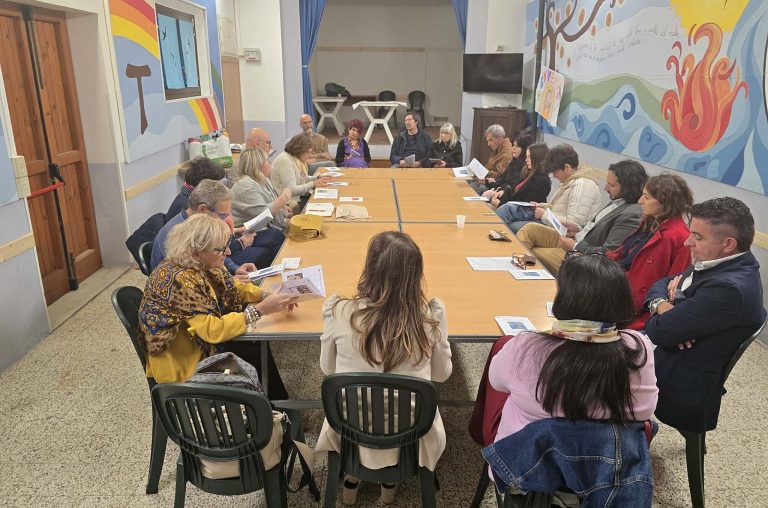
At 6:00 pm. on July 4, 2026, at the Matri Ecclesiae Shrine of the Schoenstatt International Center in Belmonte (Rome, Italy), a Mass of Thanksgiving was celebrated for the 20th anniversary of the episcopate of His Excellency Most Reverend Monsignor Ignazio Sanna, who was ordained a bishop on June 25, 2006, and appointed Metropolitan Archbishop of Oristano (currently Archbishop Emeritus of the same see), and who has been a member of the Schoenstatt Institute of Diocesan Priests since 1974.
This celebration, held in the heart and with the warmth of the faithful of the Schoenstatt Movement, was preceded by the anniversary of his episcopal ordination, celebrated on June 25 at the Cathedral of Santa Maria Assunta in Oristano (Sardinia).
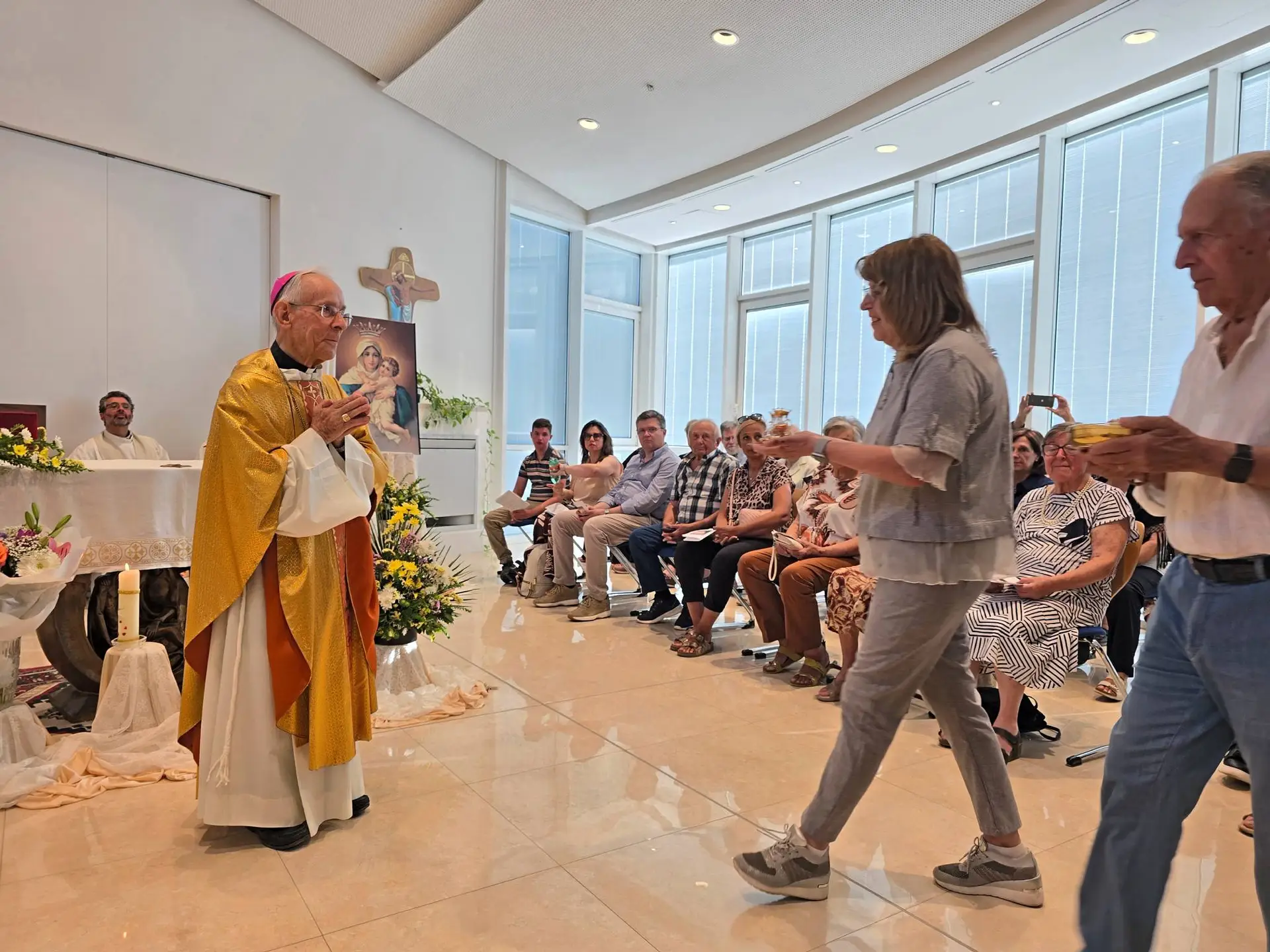
The Holy Mass of Thanksgiving for 20 Years of Episcopacy
The hall at the Belmonte Center, where the Holy Mass was celebrated, was already filled with the faithful, in an atmosphere of deep emotion and concentration. When Bishop Sanna arrived, the attention grew even more palpable and remained so throughout the Holy Mass commemorating the 20th anniversary of his episcopate. The most significant moment of the gathering was the bishop’s homily, in which he reflected on Jesus’ words: “My yoke is easy and my burden is light,” explaining that the yoke of the Gospel does not eliminate fatigue but is a burden “tailored” to human strength, borne in union with Christ.
At the heart of this reflection is the transition from a merely intellectual faith to a lived faith. It is not enough to learn doctrine: one must encounter Christ in everyday life and allow oneself to be transformed by his presence. For this reason, Bishop Sanna cited St. Augustine, Dante, and St. Francis as witnesses to a faith capable of ushering in a new life.
His recollection of his episcopal ministry in Oristano gave the reflection a personal tone. Monsignor Sanna recounted his encounters with the sick, prisoners, and those marked by suffering, realizing that the pastor’s task is to defend human dignity and to offer comfort even through a simple presence. The motto “Deus caritas est” sums up his vision of the Church: not confined to the church building or rituals, but present in the world through concrete charity, without limits or distinctions. He concluded with an invitation to hope, to communion with Christ, and to trust in the Mother Thrice Admirable of Schoenstatt.
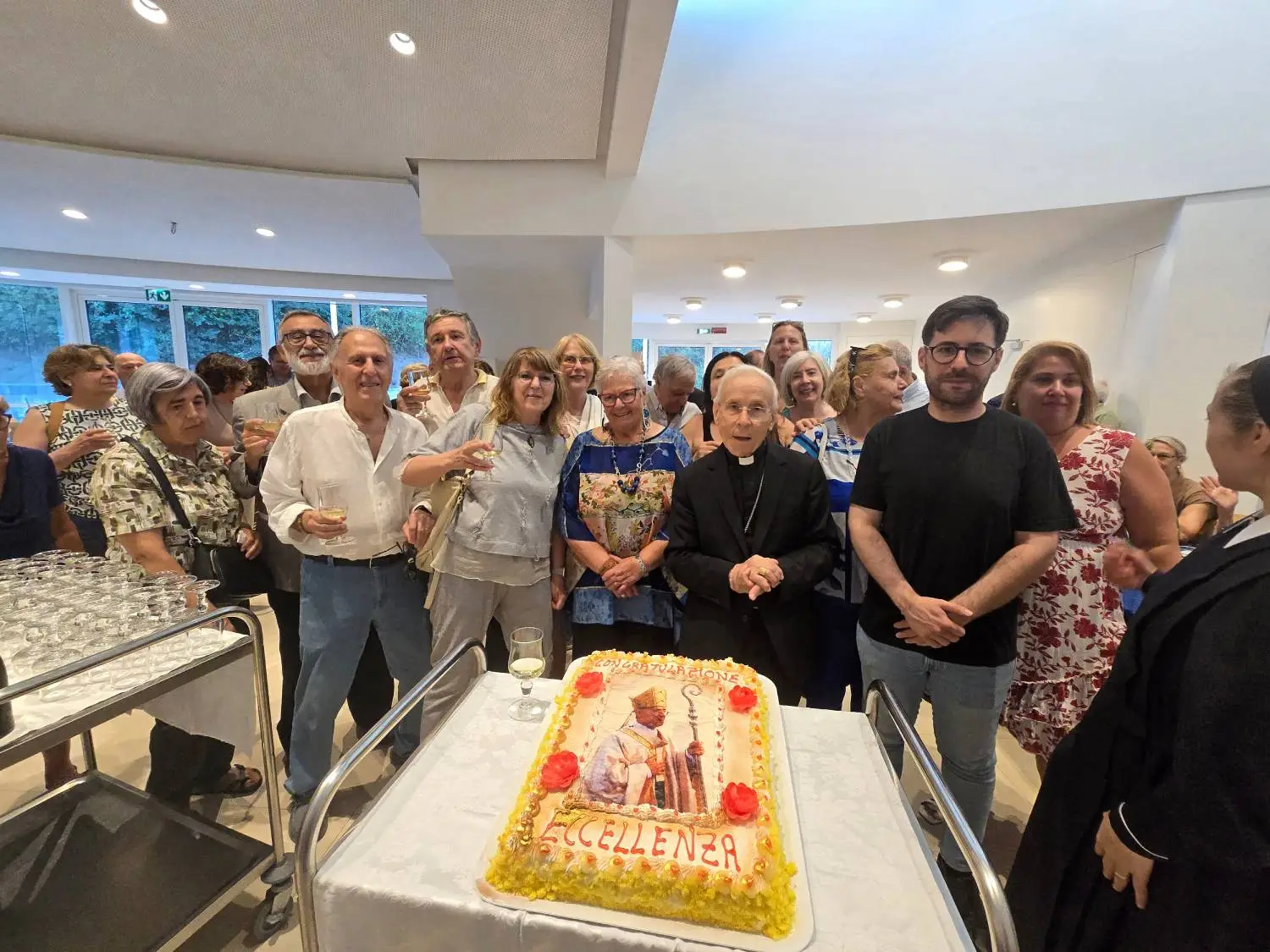
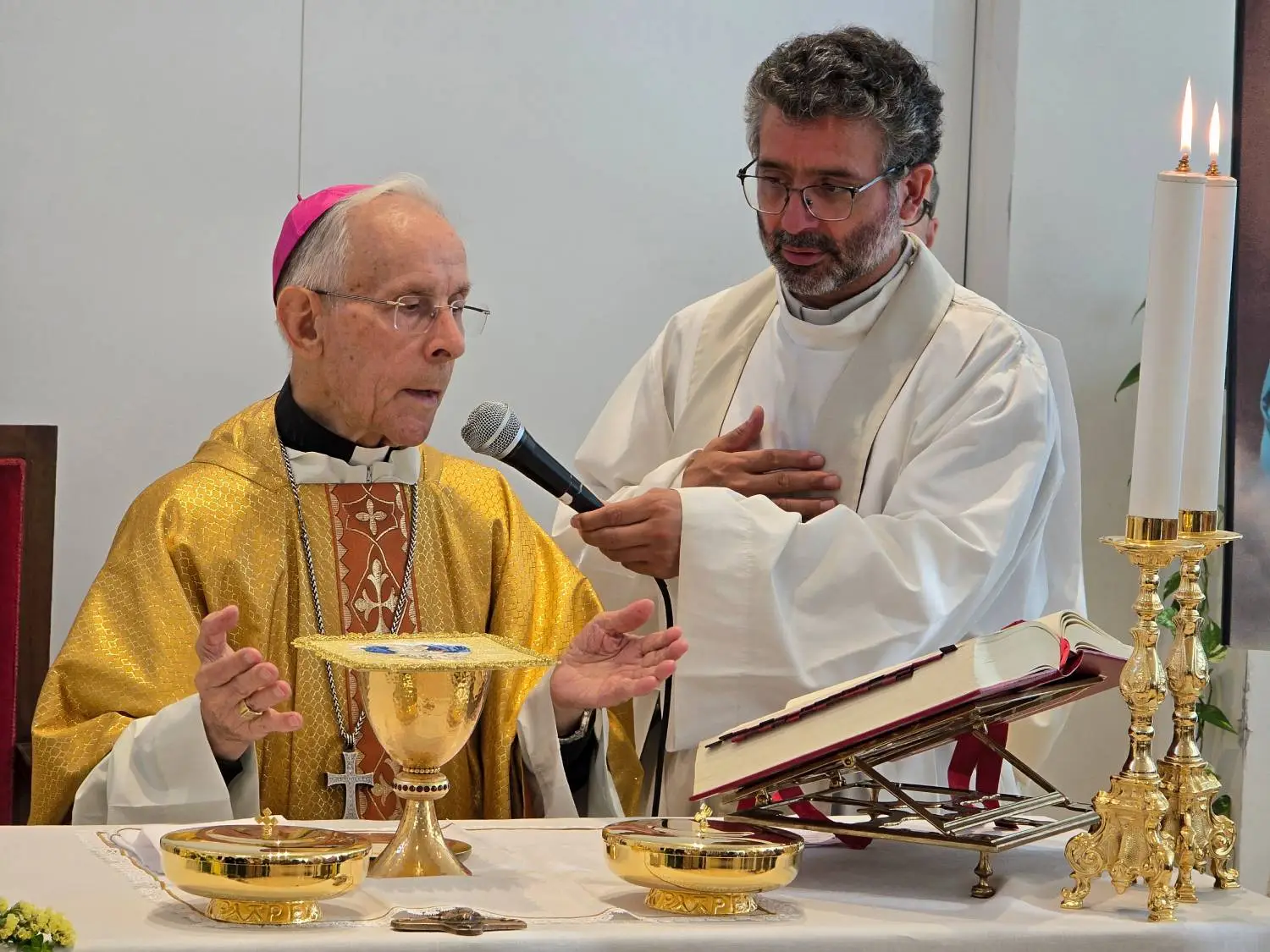
At the end of Holy Mass, Sister M. Julia de Almeida of the Sisters of Mary addressed Bishop Sanna with a greeting, expressing deep gratitude for his episcopal ministry, which he has lived out for 20 years as faithful service to the Church and the people of God. Sister M. Julia highlighted the bishop’s pastoral closeness, his attentiveness to the signs of the times, and his willingness to be guided by the Holy Spirit in both the joys and the difficulties along the way. The Rome Movement therefore entrusts Bishop Sanna to the protection of the Mother Thrice Admirable, St. Joseph, and the Holy Spirit, offering him prayers, affection, and contributions to the Capital of Grace. The message concludes with a collective expression of gratitude for a life dedicated to the Church and the Schoenstatt Movement, and with the hope that his ministry will continue to bear abundant fruits of faith, unity, and holiness.
Bishop Sanna, a new and influential figure in the Church and a deeply learned theologian
When meeting Bishop Sanna, one immediately senses his extraordinary warmth and gentleness. Yet he is a bishop of great prestige, a deeply learned theologian, and a prominent member of the Schoenstatt Movement who has decisively contributed to the Movement’s growth in Italy.
Bishop Sanna was born in Orune (Nuoro) on February 20, 1942; he was ordained a priest on March 11, 1967; elected Archbishop of Oristano on April 22, 2006; and became Archbishop Emeritus on May 4, 2019. He holds degrees in Theology (PUL – Pontifical Lateran University, April 30, 1970), Philosophy (La Sapienza, March 23, 1972), and Canon Law (PUL, June 21, 1972). Among the many positions he has held, the following stand out: president of the CEI Committee for Higher Studies in Theology and Religious Sciences; president of the Pontifical Academy of Theology; and vice-rector of the PUL. Since 1975, he has also been a full professor of Theological Anthropology at the Pontifical Lateran University.
The focus of Monsignor Sanna’s research is theological anthropology. From his first book dedicated to Karl Rahner, and subsequently in the comprehensive syntheses that followed, a coherent and unified project emerges: to understand the human person in light of Christian revelation and, at the same time, to engage theology in dialogue with the great questions of our time—from modernity to postmodernity, from biotechnologies to pluralism, and through the identity crisis. From this perspective, his contributions are directed above all toward defending the “humanity” of man, deepening the category of the image of God, addressing contemporary cultural challenges, and reflecting on the question of the future and salvation.
Among the countless publications he has authored, the following stand out: The Anthropological Christology of Fr. Karl Rahner, Paoline, Rome 1970; Notes on Anthropology, Ut Unum Sint, Rome 1979; Man, the Fundamental Path of the Church: A Treatise on Theological Anthropology, Dehoniane, Naples 1984; The Image of God and Human Freedom. Toward an Anthropology Tailored to Man, Città Nuova, Rome 1990; At Man’s Side: The Church and Human Values, Paoline, Rome 1992; Christians and Credible, L’Arborense, Oristano 2012; Guardians of the Mystery of Christ, L’Arborense, Oristano 2018; Witnesses of the Eternal in Time. The Current Challenges of Christian Anthropology, San Paolo, Cinisello Balsamo 2024.
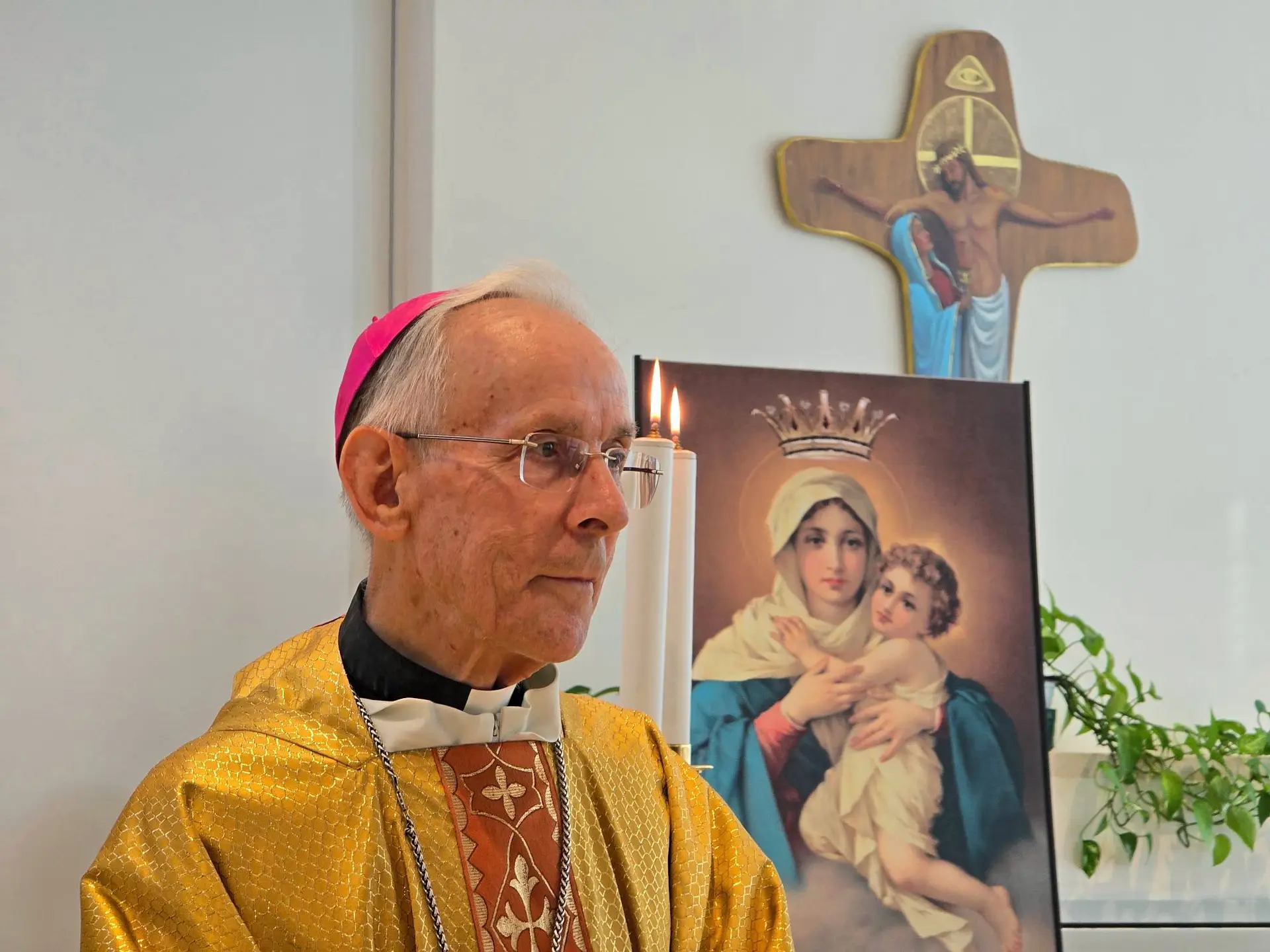
The Holy Mass in Belmonte symbolically brought to a close the celebrations marking the 20th anniversary of Bishop Ignazio Sanna’s episcopate, renewing the bond between the bishop and the Schoenstatt community. An anniversary marked by gratitude, by the remembrance of pastoral service, and by a confident look toward a ministry that continues to speak to the Church and to society.