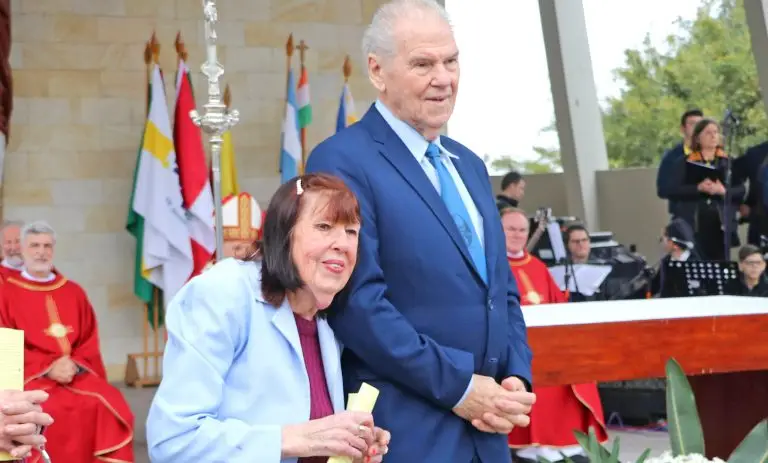
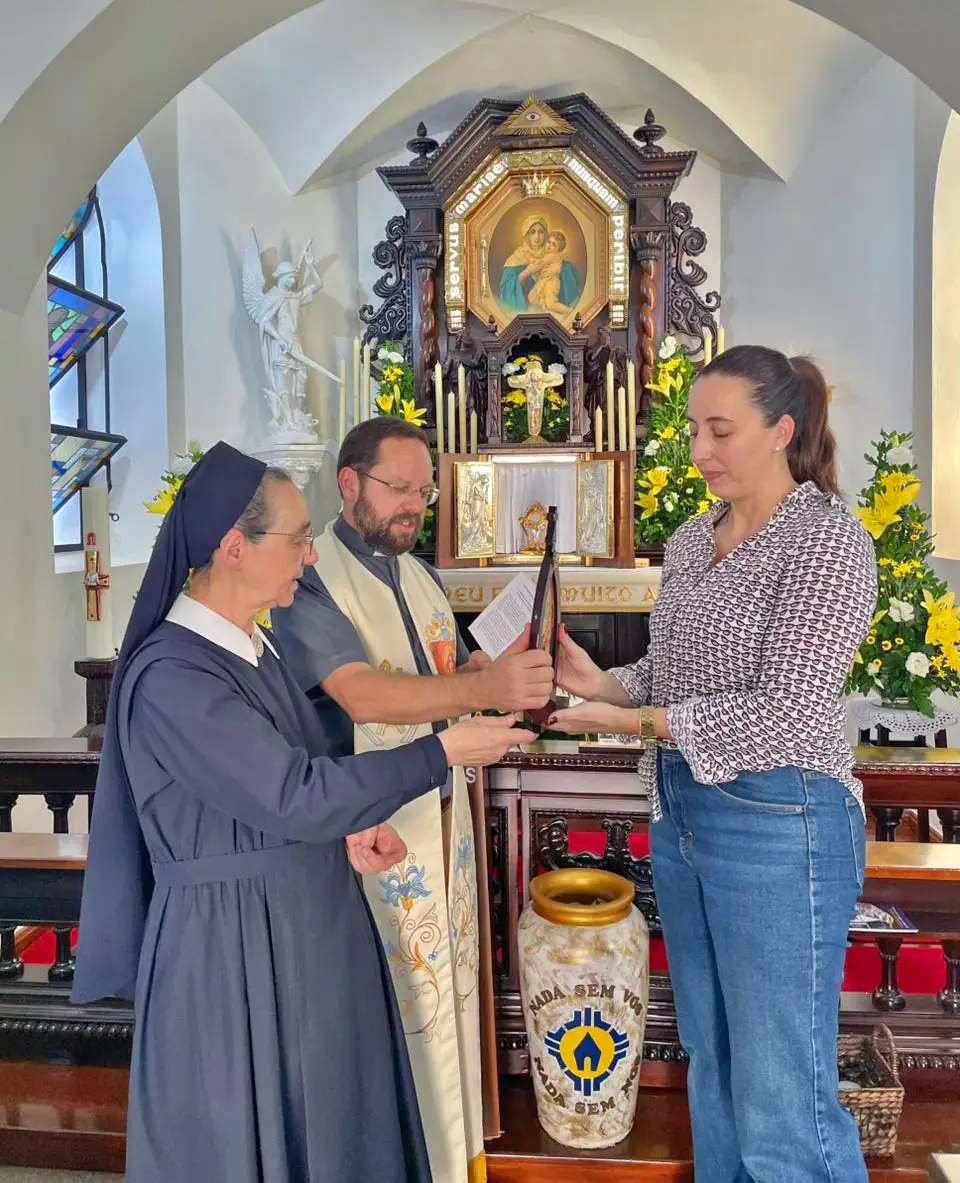
An initiative born from a personal experience of faith now spans continents. An image of the Pilgrim Mother was sent to Qatar and will be welcomed by a Catholic community made up of Brazilians and other Portuguese-speaking communities. The send-off took place on April 6 at the Schoenstatt Shrine in Londrina, Paraná, Brazil. The image was blessed by the national director of the Movement, Fr. Afonso Wosny, and the send-off was accompanied by the moderator for the Pilgrim Mother Apostolate, Sr. M. Ivone Zenovello.
A mission born of life
The image will be taken to Doha by Amanda Engmann Giraldes, who has lived in Qatar for 11 years. She moved to the Middle East due to her husband’s job; he is a biologist working in the environmental field, with a focus on coral reefs and marine biodiversity.
Since her arrival in Qatar, Amanda has sought ways to live her faith in community. “I’ve always been a devout Catholic, and when I arrived there, I looked for groups I could connect with,” she says. As a result of this search, she began participating in gatherings of Brazilians and, over time, helped start catechism classes for children.
Today, she coordinates catechism for the Portuguese-speaking community, which meets at the country’s religious center. The space accommodates various Christian denominations and allows people to live their faith in a welcoming environment. “We have a Portuguese-Brazilian community, with catechesis, a women’s group that prays the rosary, and weekly gatherings,” she explains.
The Pilgrim Mother is part of her family
Amanda’s connection to the image of the Pilgrim Mother dates back to her childhood. “I grew up waiting for the day the Pilgrim Mother would arrive. We prayed as a family; it was a very special moment,” she recalls.
The influence of her grandmother, Izaura Zuliani Simões, was decisive on this journey. “She was part of the Schoenstatt Apostolic Movement for many years and was a great inspiration to me,” she says.
The desire to bring the image to Qatar matured over time and gained strength given the current situation. “I felt in my heart that I could bring the Pilgrim Mother to Qatar, especially at this time of war,” she says.
In times of war, the Pilgrim Mother is a sign of comfort
Qatar is located very close to Iran and the Strait of Hormuz. Amanda says she stayed in Doha during the past few months, throughout the war, but recently she and her children traveled to Brazil: “My husband thought it would be best for us to leave, but he stayed there due to his job.”
According to her, Qatar hasn’t been as affected as other countries in the region, though they remain on alert. She describes it this way: “We can say that the atmosphere is normal, calm. The country has managed to intercept most of the drones and missiles reaching the city. We usually receive an alarm on our cell phones, a very loud alarm that’s a bit scary, which alerts us to take cover and go somewhere sheltered, because, with the interception of the missiles, some fragments might fall. Then they sound another alarm, saying that everything is fine and that we can return to normal life. Speaking specifically of Qatar, life remains calm, but we know that in other countries, such as Lebanon and Israel, it is different. Even Kuwait and Bahrain, right next door, are suffering greatly.”
With the arrival of the Pilgrim Mother, she sees a new sign of consoling hope. “Our faith is what sustains us. Among the women, we have prayed a lot; we’ve held some online meetings to comfort each other. I believe that the Pilgrim Mother, by being a pilgrim and going out to visit each home, will bring comfort and security; a sense of safety. I believe that is the great strength that the Mother and Queen can bring us, through her intercession with Jesus, with God, at this moment.”
Reception in Qatar
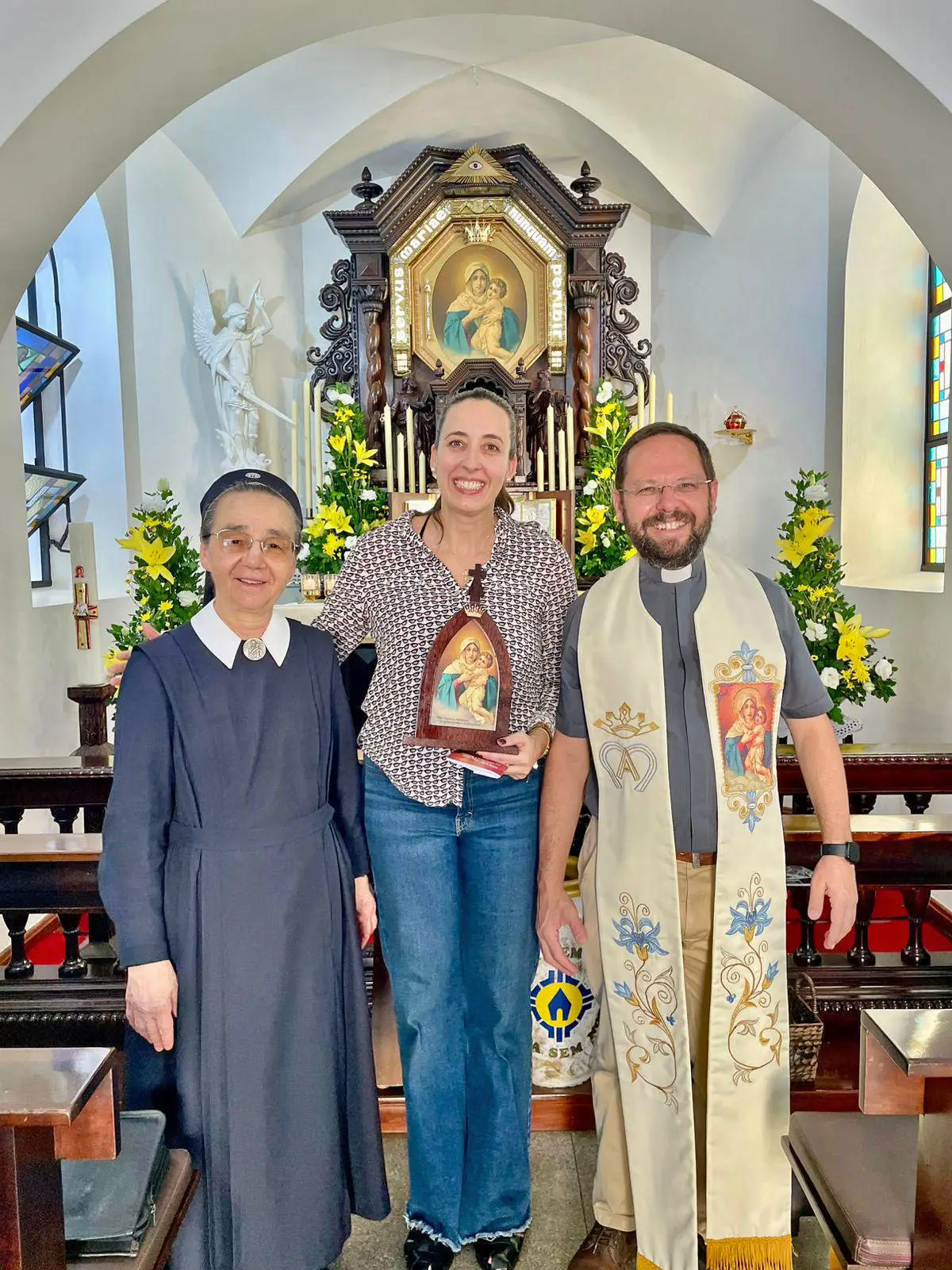
Amanda is leaving for Qatar later this week. There, the image will be received by the Portuguese-speaking Catholic community. The plan is for the Pilgrim Mother to visit families, strengthening prayer and the life of faith. “Many people have already told me that they received the image when they were children and that they would like to experience the same with their own children,” she shares.
Despite restrictions on public gatherings, religious practice is permitted in private settings and within the religious compound. “We can live our faith within our homes and in that space; therefore, the mission will be possible,” she explains.
An Invitation to Take the First Step
The goal is for the presence of the Pilgrim Mother to strengthen the bonds between families and the community. Amanda also expresses a desire to deepen spirituality and, in the future, to promote spaces for formation and prayer.
For those who feel a similar calling, she extends a direct invitation: “Go after it, explore the possibilities, and try to make this a mission. That is what Our Lady needs: people who want to bring this grace to others.”
Source: schoenstatt.org.br
Translation: Maribel Acaron