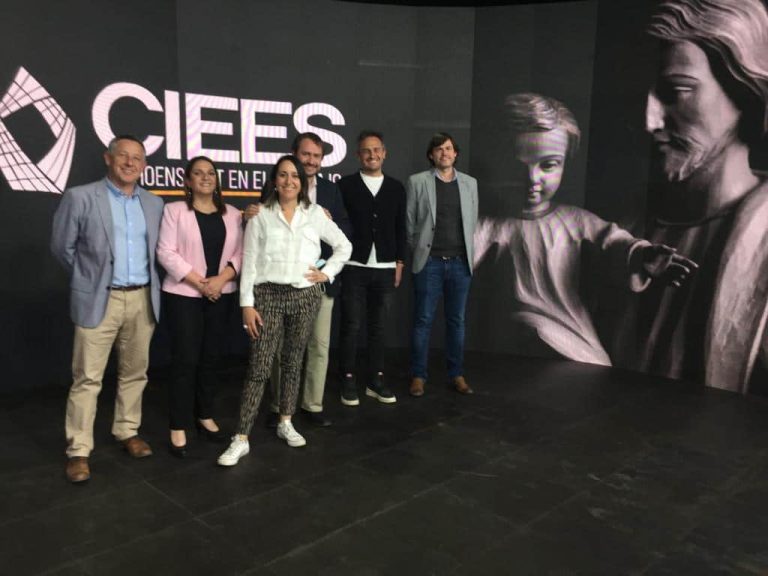
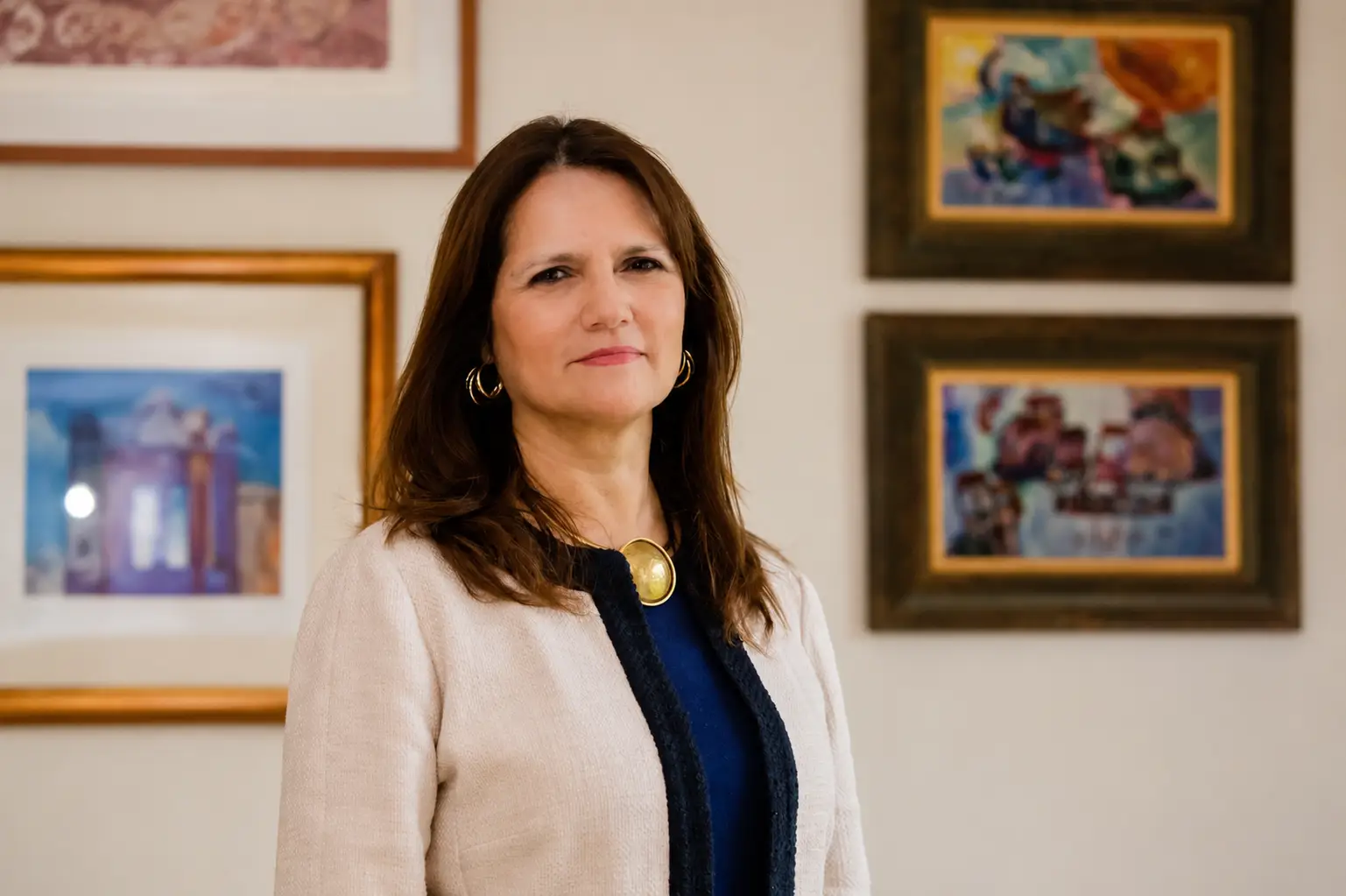
Carmen Domínguez, a member of the Schoenstatt Family Federation in Chile, was elected on June 23, 2026, to the United Nations (UN) Committee on the Rights of the Child for the 2027–2031 term. The Chilean attorney received 112 votes in a New York election, securing one of the nine seats contested by 16 candidates.
With more than 35 years of experience in civil law, family law, and children’s rights, Carmen will assume this new international responsibility in March 2027. For her, however, this professional path is deeply tied to a conviction that has also shaped her life in Schoenstatt: putting the gifts and abilities she has received at the service of others.
Carmen, could you tell us a little about your career and the path you’ve taken so far?
I’ve had the opportunity to work for 29 years at the Pontifical Catholic University of Chile in Santiago. There, I’ve also been able to carry out an important apostolate and grow professionally and personally in a place where the Lord’s presence and ecclesial life are integral to its history and identity.
This has always been a driving force behind my work in the apostolate and my willingness to perhaps step out of the comfort of my own life. For several years, I served on the legal advisory team for the Chilean Episcopal Conference and collaborated with the Church on various matters. All of this has strengthened a deep conviction within me: that we must be of service to others and contribute, with the abilities we have received, wherever we are called to do so.
From the moment I began working at the university, I quickly became involved in family-related work. One of the university presidents asked me to establish a center dedicated to studying and promoting the family within the university, and I directed it for 13 years. The Center has played—and continues to play—a very active role in the development and debate of public policies in Chile.
I have also served as a lawyer—that is, as an associate justice—on the Santiago Court of Appeals, where I likewise had the opportunity to hear and decide family law cases.
That is how I began a long career focused on issues affecting families and children. For many years, I have conducted research on these topics and participated in forums debating public policy in Chile. I have also been actively involved in Congress, contributing to discussions on bills that affect families and children, and have served on presidential commissions addressing the living conditions of families, children, and adolescents.
What did it mean to you to receive the news of your election to the UN Committee on the Rights of the Child?
Of course, it was a great joy. It’s very difficult to be elected, because the Convention on the Rights of the Child is the most widely ratified international treaty in history: it has been ratified by every country in the world except the United States. So, in this election, practically every country in the world was voting.
My candidacy was submitted a month and a half before the election, and normally, these candidacies are submitted well in advance. For that reason, we had to complete all the work in a very short time. And, well, thank God, together with the Chilean Ministry of Foreign Affairs, we were able to carry out our work very professionally.
I had to travel to New York during that time, where I met with 35 election officials from around the world. That experience alone was an honor and a great opportunity. Being elected, of course, is a great honor. Before me, only one other Chilean had served on the Committee, which consists of 18 members and whose membership is renewed every two years.
It is also a source of joy for my country, which was deeply committed to this candidacy and the election. However, once I take office as a member of the Committee, I will not represent Chile; rather, I will be part of an international body responsible for monitoring States that have ratified the Convention and their compliance with the commitments set forth therein.
Could you provide us with more details about the Committee on the Rights of the Child’s work?
The Committee’s main task is to review the reports on compliance with the Convention that all States that have ratified it must submit every five years.
The Committee carries out its work in Geneva, where the United Nations human rights bodies are headquartered. My job involves attending the regular sessions—which are generally held three times a year—but it also entails conducting the research and preparing the reports that are reviewed during those sessions.
Childhood cuts across absolutely every aspect of life, and therefore many subjects and areas will need to be studied, and I will have to delve into them more deeply, because, obviously, I am not an expert in all of them, nor is it possible to be an expert in all of them.
I join the Committee with the conviction that we must continue to strengthen the protection of children. No country in the world can claim to have perfect protection. The challenges are enormous, and, in a sense, the needs and problems that States must address in this area are ongoing.
Consider, for example, the challenges that digital media, social media, and artificial intelligence pose for children today. These are areas in which we have no prior historical experience and therefore require a strong capacity to identify both the advantages and the risks and problems they may pose for children’s integral development. In that sense, I take on the responsibility of serving on the committee with great pride, knowing that it is an enormous challenge.
How did the Schoenstatt Movement become part of your life?
I came to Schoenstatt at the end of my first year of college because one of my classmates was a Schoenstatt member. That same year, I met my husband, who was in the same Boys’ Youth life group as my classmate.
It was precisely during the Month of Mary—which in Chile is celebrated from November 8 to December 8—that I began dating, as we say in Chile, the man who is now my husband. I was active in the Girls’ Youth throughout my college years, as was he, who at the time was a founder of the Pioneers. Back then, we lived in Concepción, and our shrine was the Montahue Shrine.
Later, we moved to Madrid to pursue our doctoral studies, where we continued to participate in the Movement. There, we joined the Family League. We later returned to Chile and moved to Santiago, where we joined the Family Federation, which we continue to participate in today.
Schoenstatt has been a very important part of my life and, above all, a meaningful way to live out my spirituality and deepen my faith.
In addition, I have been blessed always to have a group: first in the Girls’ Youth, then in the Family League, and finally in my Federation group. These groups have been—and continue to be—a pillar, a source of support, and a very important foundation for my life and my family’s.
For this very reason, the Blessed Mother has been a constant presence throughout our lives. Honestly, I couldn’t speak of myself or imagine my life without the Lord and the Blessed Mother.
What hope do you see for the new generations, despite the challenges children face today?
Of course, it is sometimes very difficult to look with hope toward the future development of humanity and, consequently, toward the future of child protection. It is difficult to do so when one sees such serious armed conflicts in the world that seem never-ending; when one sees the poverty that persists in so many places; or when one sees the violations of the human rights of children and adolescents in so many parts of the world.
On the other hand, one must always believe that progress is possible and increasingly recognize the need to protect children. In a way, there is greater awareness of this need today than ever before.
For now, we have the Convention on the Rights of the Child, and the states that have ratified it are internationally obligated to develop policies, measures, and standards to ensure that every child—boy or girl—can become the wonderful person they are meant to be.
So, while it is true that, on the one hand, there are discouraging situations and we see how thousands of children are affected and limited on a daily basis—with their real opportunities for development becoming very complicated—on the other hand, it is also true that, as never before, there is greater awareness that they must be protected.
Today, it is increasingly recognized that children and adolescents are subjects of law and, therefore, possess a dignity that must be respected. I believe this is precisely where we can find a reason to look toward the future with hope.
Is there any experience at the Shrine or in the life of the Covenant that has shaped your preparation for this mission?
Perhaps the most important experience of my life and of the Covenant of Love, which prepares me to take on this new task, is the clear experience I have had at various moments, even in the difficult circumstances I have had to face: the absolute certainty that the Lord and the Blessed Mother are with me.
I am not taking on this task alone, but hand in hand with them. I am convinced that if God has placed this task in my life, He will also give me the strength necessary to carry it out and, above all, will encourage me to do so with the rigor, seriousness, and professionalism this mission requires.
As I have said before, it is an immense task. It requires a great deal of work, in addition to the responsibilities I already have here in Chile. I have my husband and my family, and, of course, a number of other personal and professional responsibilities that obviously will not be put on hold because I am taking on this new task. But ultimately, I accept it with the confidence that I am not carrying it out alone.
How can members of the Schoenstatt Movement concretely promote and defend children’s rights in their daily lives? What message would you like to share with the Schoenstatt Family as you assume this international responsibility?
The concrete way in which all Schoenstatt members can contribute to improving children’s living conditions and to promoting and defending their rights is, first and foremost, within their own families. If they are parents, they can do so by truly accompanying their children’s development at every stage of their lives and providing them with the best possible conditions to grow and develop fully.
Furthermore, Schoenstatt members who have the opportunity to work in various settings—whether within the Church or in the countries and communities where they live—can actively engage in tasks related to the formation, education, and support of children. They can contribute to their education in values and work to ensure that all children have genuine opportunities to develop under the best possible conditions.
We know that the future of nations and humanity rests on the shoulders of younger generations. It is they who, when they reach adulthood, will take the helm. Therefore, everything invested in their formation, education, and development is essential to improving the living conditions of children throughout the world.
We Schoenstatters also have a special vocation to promote and defend the family. That is why I believe we are called to embrace this vocation as a concrete commitment: wherever we are, we must work to promote respect, dignity, and the protection of all children.
That is precisely the message I would like to leave with the Schoenstatt Family: our vocation for the family and for building a more humane world also translates into an effective commitment to the protection and integral development of every child.