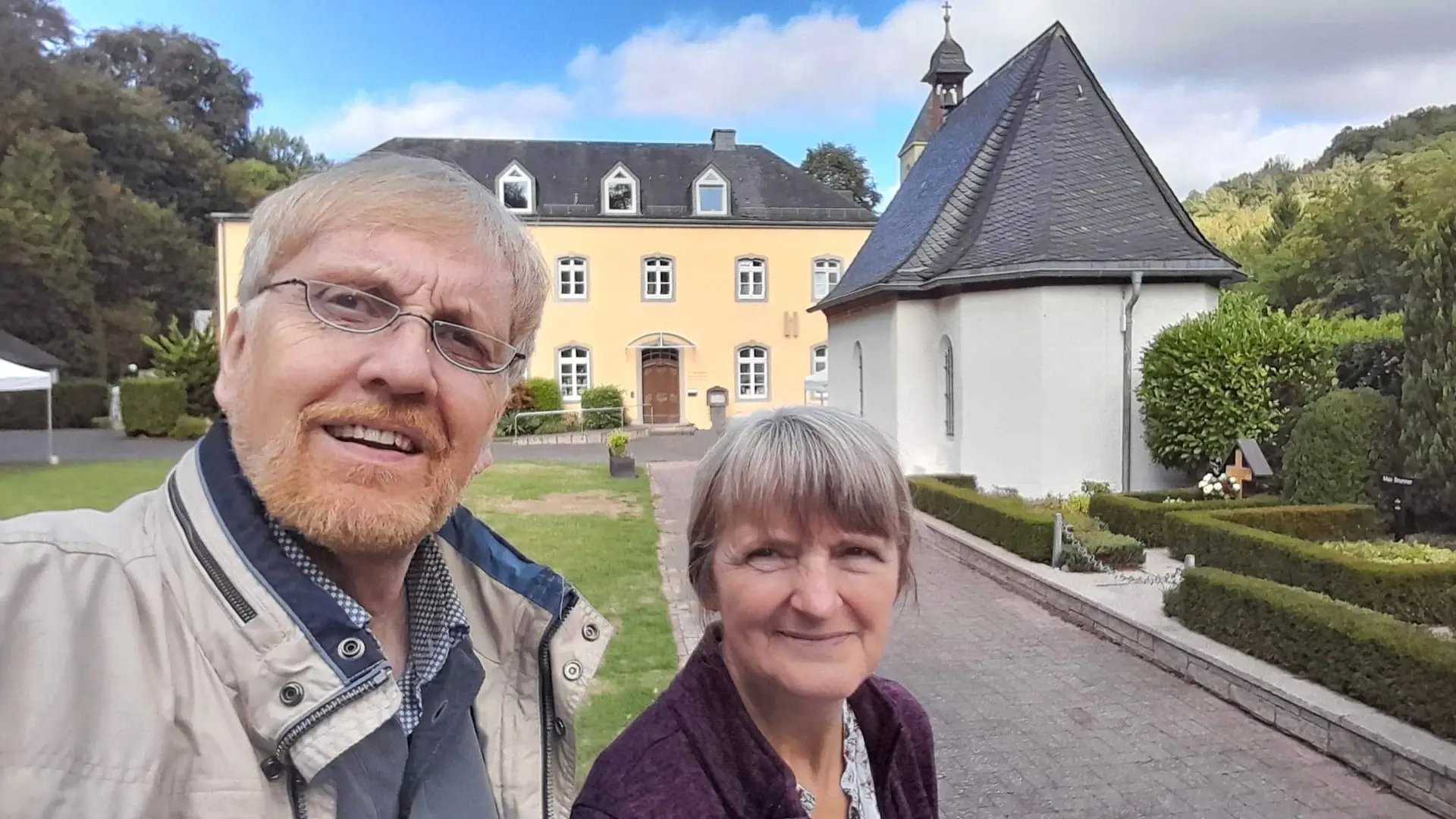
Anyone who has visited Schoenstatt over the past 13 years has surely encountered Norbert and Bernadette Weweler. In 2013, they took on the task of working in the sacristy of the Original Shrine—a quiet but indispensable service that supports the well-being and welcome of the many pilgrims who come to this place of grace.
This August, after 13 years of commitment, dedication, and love for this task, Norbert and Bernadette are stepping down from their work in the sacristy. The couple, who belong to the Schoenstatt Family Institute, will remain in Schoenstatt and live at the Bundesheim. During the transition period, until new people take over this role and become familiar with their duties, they will continue to lend their support.
During this time, the couple has witnessed unique and formative moments in the recent history of the Schoenstatt Apostolic Movement. Amid celebrations, pilgrimages, gatherings, and so many events at the Original Shrine, they have also encountered many stories, people, and experiences that have touched their hands and their hearts.
As this chapter comes to a close, Norbert and Bernadette share some of these memories and reflect on what it has meant to serve at the heart of the Schoenstatt Movement for so many years.
You have spent many years serving as sacristans at the Original Shrine. How did this calling begin, and what motivated you to take on this role?
On September 1, 2013, we began serving here as sacristans at the Original Shrine, taking over from the Fellhofer family of Vienna. When we arrived, the Night of the Shrine was in full swing, with 400–500 young people. After getting only two hours of sleep on our first night, we said to ourselves, “We can’t do this; we have to go home…” But things got better after that—and we ended up staying after all.
What drove us? What prompted us to volunteer for this task? During a course meeting—we’re part of the Schoenstatt Families Institute—in February 2013, we heard for the first time that a new couple was being sought to serve as sacristans at the Original Shrine. At first, it went right over our heads. Then, during that same meeting, it came up twice more. Suddenly, we both felt personally addressed. We met quietly in our room and looked at each other: could it be that the Blessed Mother meant US? That was a very moving moment for us—first, the sense that we could truly feel a calling there, and second, the fact that we both felt that way (it’s extremely rare for us to be enthusiastic about the same idea at the same time…).
Then we came back down from our “Tabor experience” and began to think it over: we had a carpentry business and a parquet flooring studio that our children wouldn’t be taking over, since they had all chosen different paths in life. From that point on, nothing stood in the way of this new path. But other circumstances made it almost impossible to even consider moving away from our home region—Westphalia. There were our fathers: Norbert’s father was suffering from severe dementia, and we were tied up caring for him along with his mother. Then there was Bernadette’s father (91), who also mainly had his daughter nearby as his primary caregiver.
There were serious reasons that argued against us warming up to such an idea—and we were back to reality. We drove home and carried on with our lives. Less than four weeks later, the father with dementia died quite suddenly—and we had the impression that the Blessed Mother was preparing something.
Then came May 22, with the donation of the Original Shrine to the Schoenstatt Family. In early June, the request came to us. At first, we held our breath because so many things still stood in the way of this plan. We let Providence take its course. After we shared our desire with our family—and, surprisingly, received strong support—one thing led to another: a very good solution was found for my mother, who was now on her own. Our dog wouldn’t be left alone. Our coworkers received job offers from other companies. Then, in early August, when Bernadette’s father also passed away after a hospital stay, we knew for certain where the Blessed Mother wanted us to be. So, we arrived here with two suitcases and were able to live in House Nazareth for four weeks until we found an apartment to rent.
Over the years, you have surely experienced many special moments—some known to the entire Schoenstatt Family, while others may have remained more private. Is there an experience or event that has had a particularly profound impact on you?
We have truly witnessed pivotal events right here on site: the grand 100th anniversary, 100 years of Hörde, Pentecost conventions, the Holy Year of Mercy, youth and family festivals, the COVID-19 pandemic, and significant events within the individual communities. Then there was the move of the sacristy from the Old House to the temporary sacristy containers, and this year, the 100th anniversary of the Sisters of Mary. We can’t say there is one single event or experience that has left a lasting impression on us. We try to be open to the events and encounters the Lord wishes to give us each day. And then He touches our hearts when we least expect it: in a brief conversation with a couple who celebrated their diamond wedding anniversary in the Original Shrine and radiate deep gratitude in their very being; in a truly sincere and beaming “thank you” for the beautiful flowers; in the familiarity with the people who faithfully ensure the times of adoration here every day; in the help of so many volunteers, without whom none of this would be possible. Or in a word that explains the Gospel, and when a young woman quietly seals her covenant of love at noon in the presence of a priest and continues her day beaming with joy. It touches our hearts when priests have time before or after Holy Mass to hear confessions, sit on a bench in the meadow, and are there for the people—for everyone. It is moving to see the large, heavy jugs filled with a store of grace that are sent up to heaven on every 18th.
What is it like to experience the life of the Shrine so closely, to prepare it for the celebrations, to care for the liturgical objects, and to welcome pilgrims from so many countries every day? What has this shared experience awakened in you?
After we had been serving for about a year or a year and a half, we celebrated the major jubilee and observed all the liturgical feasts, solemnities, and memorials, trying to help shape them wherever possible. That’s when we realized how rich and life-affirming our liturgy is. It’s lovely to consider which altar linens are particularly well-suited to these days and how we might choose flowers in colors that match. And how large should the floral arrangements be, in keeping with the liturgical calendar? For example, we also like to bring out a special chalice for feast days and Sundays to make the special nature of the day visible through this symbol as well. On Sundays, we also like to bring out the large monstrance for adoration, which holds the Blessed Sacrament: the Lord’s Day. The point is to offer HIM a special place in our own hearts.
When we think of the daily pilgrims—those who come to pray, those who happen to pass by, and those who quickly light a candle and offer a greeting to the Mother of God—we are often deeply moved: a thought like this comes to mind: “Mother of God, you have a place for everyone, you have time for everyone—your heart is so vast—everyone is welcome, and even loved. With all our thanks, all our petitions, all our longings, all our joy, and all our sorrow. In sickness and pain, and in jubilation and festive celebration. You are here.” This never fails to move us, and sometimes we are allowed to stand by the Blessed Mother’s side for a little while and perhaps serve as her voice. When someone asks for our prayers, or asks if we can light a candle for a special intention, or when we simply listen—and sometimes offer a little comfort or share in their joy.
It is truly beautiful when people travel from far away to visit the Original Shrine for the first time—sometimes after saving for years to do so. They are often deeply moved to finally be at the place of their longing, where the Covenant of Love began. Filled with tenderness or exuberant enthusiasm, they first approach the Shrine, formally “embracing” it at one of its corners. They then take photos from the right and left, from above and below, before entering the Original Shrine to encounter the Mother and Queen. There, it usually grows very quiet, and you can sense the closeness between Mother and child.
There are also groups that go on a pilgrimage through Europe, and Schoenstatt is just one pilgrimage site among many. Then the question often comes up: What kind of Marian apparition took place here, or what kind of miracle occurred? And our pilgrimage sisters are simply good at highlighting what makes our Original Shrine so special.
The Original Shrine welcomes people every day, each with their stories, joys, sufferings, and petitions. Has there been an encounter with a pilgrim or a situation in the sacristy that deeply touched both of your hearts?
Yes, such encounters happen from time to time. For example, I recall the large Polish pilgrimage. I remarked to a woman how lovely the atmosphere was, and she told me, “We’re not even here as part of this pilgrimage. It’s a huge ‘coincidence’—we didn’t even know a Polish pilgrimage was taking place today.” She explained: “My sister just came from Poland so she wouldn’t feel so alone after our mother’s death, and we decided to come to Schoenstatt. I know Schoenstatt a little, but my sister doesn’t know it at all, and that’s how we ended up here. And we’re so moved.” Both women were deeply grieving their mother’s death, and I had time to simply listen and be there. That did both of them so much good—and me, too. Something truly grew within us. This sister now brings flowers to the Candlelight Chapel more often and then sends a photo of the Shrine to her sister in Poland. When her sister is here, they come to the Shrine together to pray. We’re always happy when we meet.
Once, a young woman who had brought her children to an event at Wasserburg asked about the Original Shrine—what kind of place it was. We told her a little about it, and then she said she’d love to go to confession again in her native language: Czech. Every now and then, there’s a Czech pilgrimage here, though it’s rather rare. But right now, a group from the Czech Republic is here, and two priests are traveling with them. She was completely fascinated and sought us out; the next day, we saw her sitting on a bench in the Pilgrims’ Meadow with one of the priests. Later, she came back to thank us. We could only pass this gratitude on to the Blessed Mother with wonder, who had arranged everything so wonderfully.
Now that you are stepping down from this role, what do you take with you from these years of service? And what message would you like to leave with the Schoenstatt Family, who will continue to come to the Original Shrine?
When we listen to our hearts and hear God’s voice there, we experience various feelings: perhaps they can be summed up as “a sense of home and a sense of being pilgrims.”
We were able to put down roots in the Original Shrine through our many encounters, our work, the silence, and the liturgy. The Blessed Mother drew us to herself there, allowing us to grow—both personally and as a community. That gives us a sense of security—a sense of home, in other words.
Over time, our journeys from the home shrine to the Original Shrine and from there to all places—to our children and grandchildren, friends, and acquaintances—have become pilgrimages for us. We are called to carry what we have experienced as a gift into the next phase of our lives and to pass it on: the love of God and His Mother, which is tangibly alive in the shrine. We hope it will open our hearts to those whose paths cross ours and to those who walk with us, and prepare our hearts for the steps that now lie ahead on the pilgrimage before us.
The message remains: It is good to be here; we want to build our homes.
A Prophetic Image
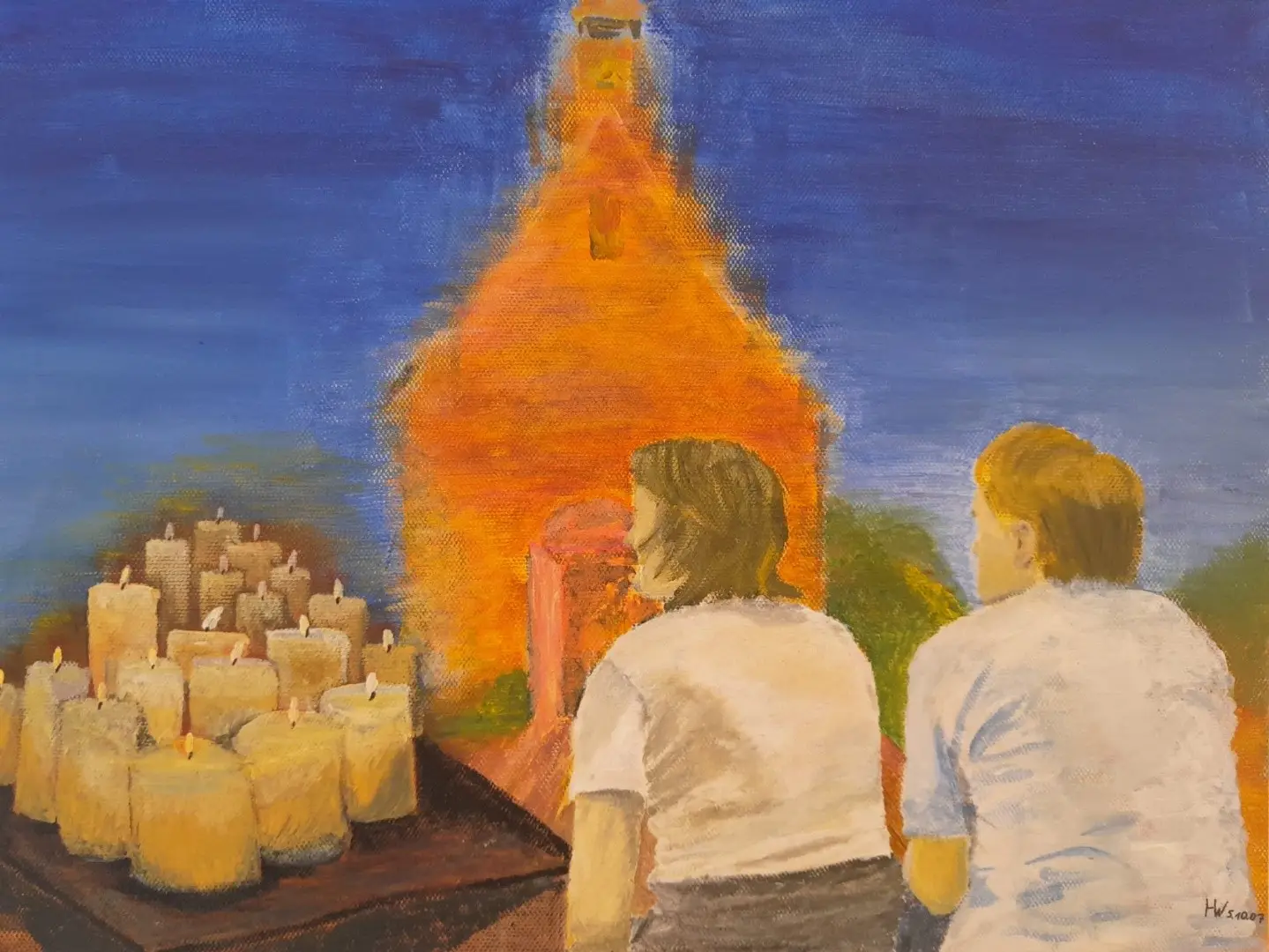
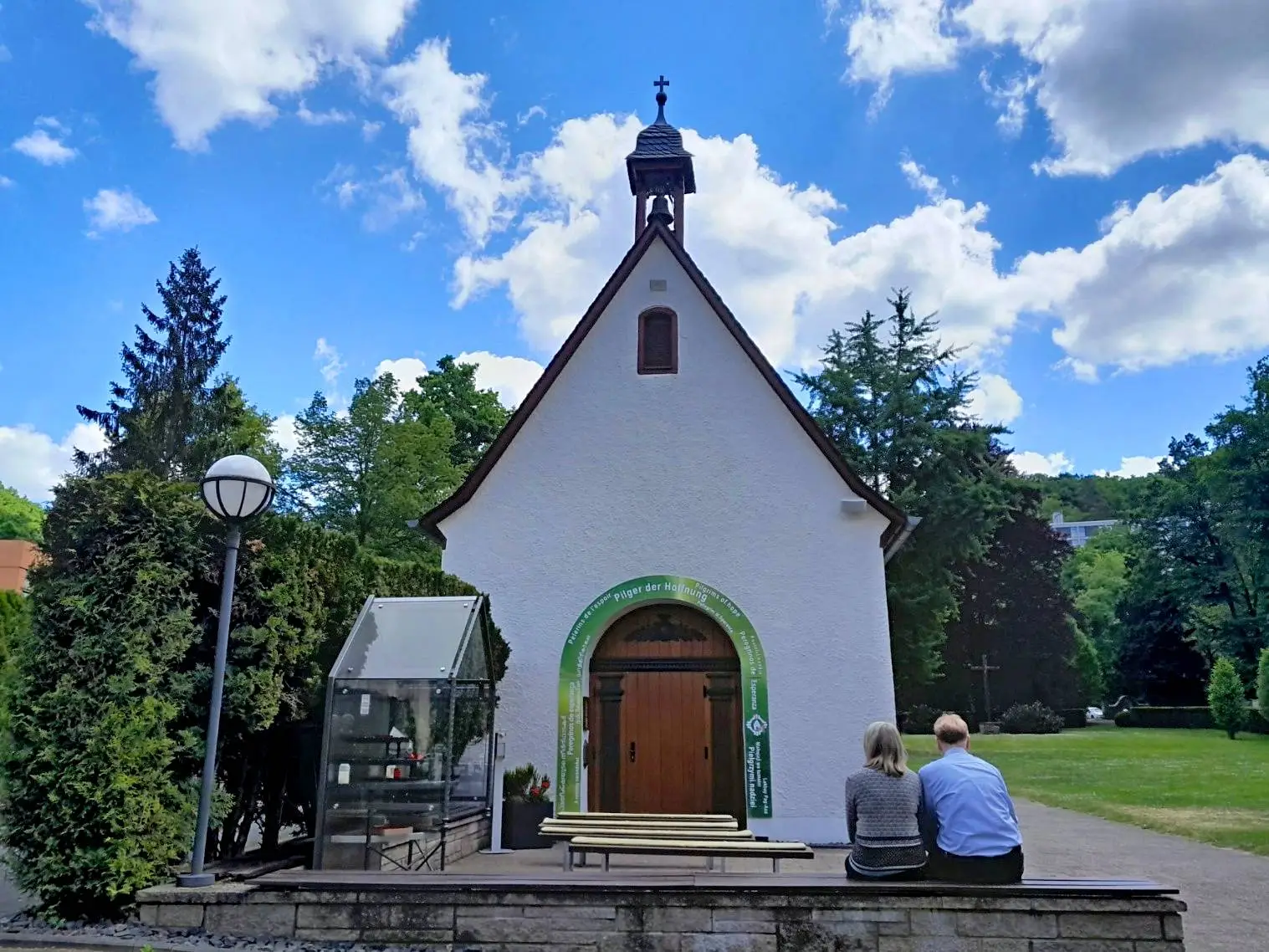
Something we’d like to share:
When we moved in 2013, we packed everything into boxes and unpacked them little by little. Among our belongings was a painting given to us by a friend in our hometown, Gütersloh-Spexard. In the painting, we can see the two of us, Norbert and Bernadette Weweler, sitting on the bench in front of the Original Shrine. However, when we arrived in Schoenstatt, the Shrine did not yet look like that. Previously, there were two large trees on the right, on the pilgrims’ lawn, and in front of the Shrine there was also a hedge. The Original Shrine was adorned with green foliage, and the canopy was on the right, next to the Shrine wall.
But after a year, everything had changed: the trees were cut down, the hedge was removed, and the green foliage was cleared away. The canopy was finally placed—after several “temporary locations”—on the left, at the front.
But here’s something very special: this painting was created about 6 YEARS BEFORE WE MOVED TO SCHOENSTATT! When our lives were still completely different. So it was a prophetic painting!
And here’s a fun fact: On “The Night of the Shrine,” the Original Shrine was also lit in red—just as you can see in the painting.
We took the corresponding photo last year, exactly 18 years after the painting was completed.