
“The truth is that, through the Covenant of Love, we are launched into space.” [1]
Today, the cell phone you hold in your hands has more computing power than all of NASA did in 1969, when it sent the first two astronauts to the Moon.
Technology has evolved, and with it, expectations for discoveries and advances in space research have grown.
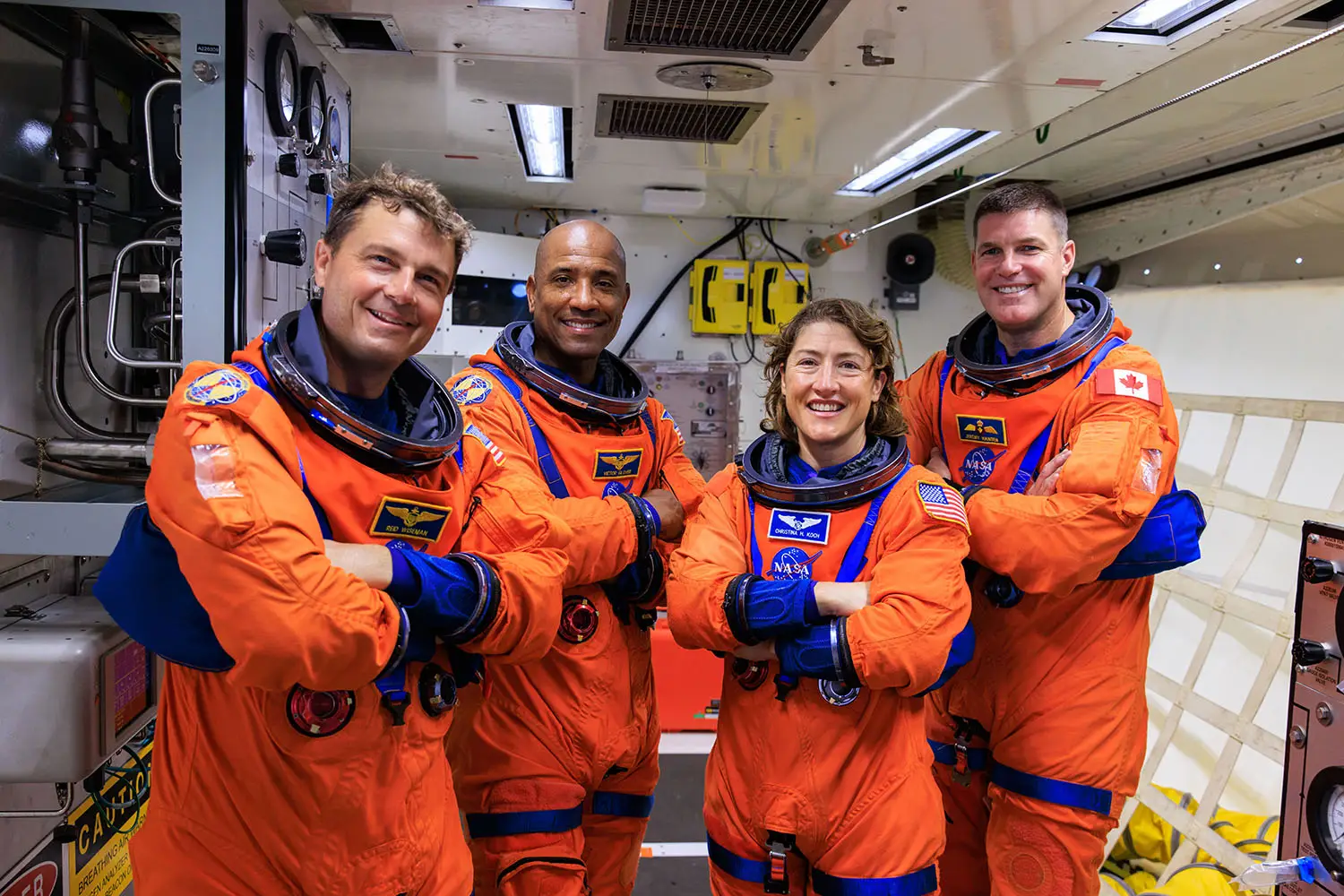
This Monday, April 6, the crew of the Artemis II mission entered lunar orbit for a historic 10-day journey, marking humanity’s return to that environment after more than 50 years. They reached the farthest point from Earth that humans have ever traveled.
The four astronauts will not land on the Moon in the coming days, but will orbit it to photograph and describe its physical characteristics.
“We all have to be astronauts” (Fr. Kentenich)
Fr. Joseph Kentenich did not witness the first human landing on the Moon. He passed away in 1968, and it was not until the following year, in 1969, that Neil Armstrong, on the Apollo 11 mission, took that “one small step for a man.”
However, Fr. Kentenich experienced the beginning of the space race, humanity’s entry into space, and the preparations for the Apollo 11 mission.
As we know, he sought to discover God’s action behind every small event and never missed an opportunity to lift the mind and heart toward the supernatural.
In the early 1960s, news about the first space flights by the Russians and Americans dominated public opinion. Fr. Kentenich recognizes the greatness of human intelligence as a gift from God—and looks beyond it—; he engages in a profound reflection in which he compares the goal of space flights with the meaning of human life: “Which spaceship should we board? We must enter into the spirit of faith! Then, in time, we will be able not only to overcome the Earth’s gravitational pull and conquer the world (…), but we will finally succeed in reaching, beyond the world, the heart of God. Therefore, we all have to be astronauts.” [2]
How did he interpret man’s journey into space?
Fr. Kentenich offered several interpretations of this historic moment. In one of them, he himself tells us:
“I will tell you how I personally interpreted it. Let us imagine a man inside the spaceship ascending upward. He quickly overcomes the Earth’s gravitational pull and continues moving further and further, penetrating other worlds. I, personally, thought: in reality, this is the meaning of our life. What must we do? Overcome the world, enter the spaceship! But which spaceship? […] Which spaceship should we enter? We need to enter into the spirit of faith! Then, in time, we will be able not only to overcome Earth’s gravitational pull, to conquer the world, to penetrate and fly into other celestial spheres, but we will finally succeed in reaching, beyond the world, the heart of God.” [3]
Schoenstatt as a Spaceship
In other interpretations, our Father and Founder refers to the Covenant of Love and the Schoenstatt Family as “ships” that are meant to carry us upward, to heaven. However…
“We do not intend to abandon the world; that is not our vocation. We remain in the world; we remain faithful to one another […]. But we do not want to immerse ourselves in these realities. We are of this world; we rejoice with the world, but we use it to lift ourselves to God and enter into the Father’s heart: sursum corda! (lift your hearts) We were born for the highest.” [4]
This means that, while we lift our spirits to heaven, we keep our feet firmly on the ground.
A challenge in the 1960s and today
One of the main risks of space missions is leaving Earth’s orbit. This was a challenge in 1969 and remains so for the Artemis II mission. It is always risky. Speaking of this, our Father says:
“We read in the newspapers about plans to travel to the Moon and go into space.” What is the difficulty? As long as the space capsule is under Earth’s gravity, everything is fine. But what will happen when it goes out into outer space and falls under the Moon’s gravity? Do we understand the analogy, and can we apply it to our lives? We are affected by the world’s gravity; we are under the influence of the things around us. We must remain under the influence of the ‘Sun,’ which signifies God. Who will help us? The Holy Spirit. I do not mean that we should detest the world or that we should not look at it. The Heavenly Father created the earth. The world came from God. We must use and enjoy things, but not become their slaves” (1959). [5]
We can imagine that, if Fr. Kentenich were with us, he would continue to interpret world events in the light of faith. Perhaps he would tell us the same thing he told couples in the United States: “He (the astronaut) conquered the world and the laws of the world. We must all also be conquerors of the world” [6].
[1], [2], [3], [4], [6] Father Joseph Kentenich. Monday Evening talks with Families. Vol. 21 – Our Life in the Light of Faith. Mother and Queen Society, Santa Maria, Brazil.
[5] Fr. Joseph Kentenich, Let the Roses Speak for Us. Published by pioneer couples of the Schoenstatt Movement in Milwaukee, USA.