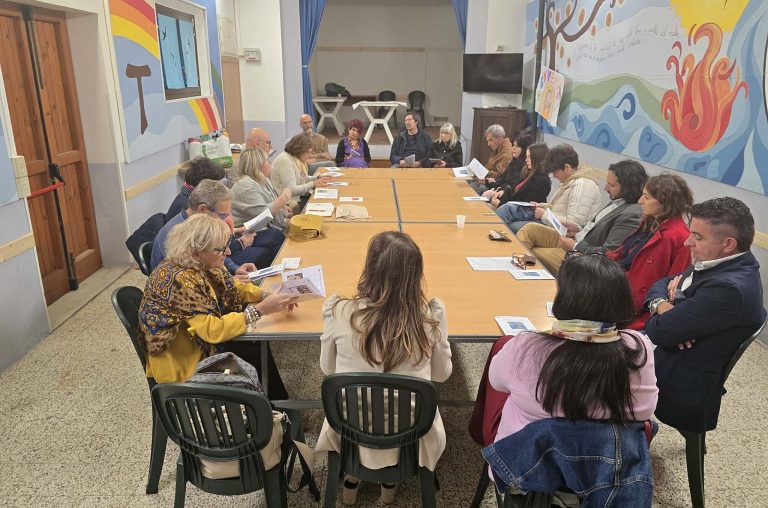
On Saturday, September 26, and Sunday, September 27, the Schoenstatt Family of Italy gathered at the Belmonte Shrine in Rome for the 2026 National Pilgrimage. The theme chosen for the gathering, “Let’s Go Home,” expresses the desire to come together at the Shrine as children of the same Family, renew the Covenant of Love, and take up the mission together once again.
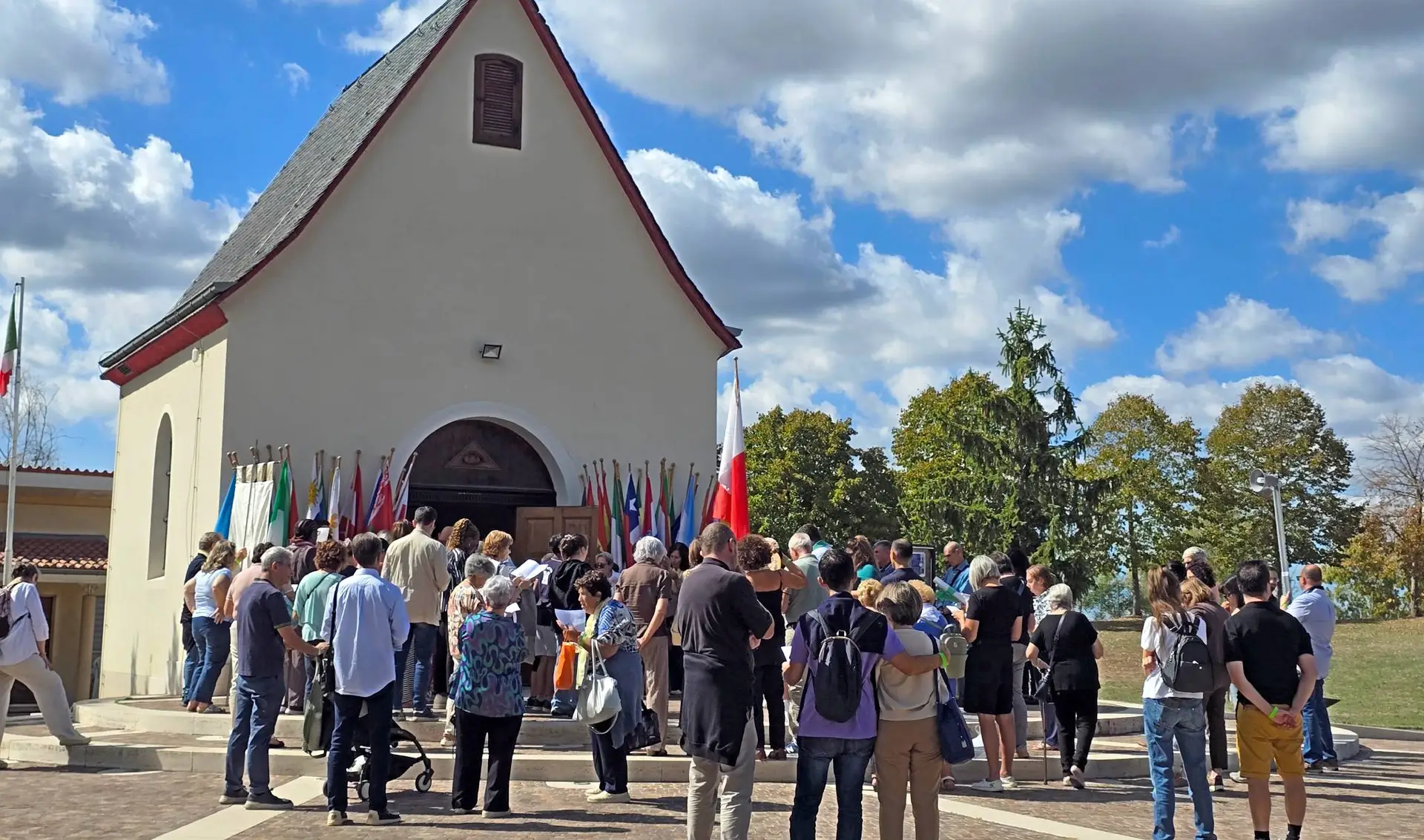
Two days of Prayer, Fellowship, and Testimony
The pilgrimage began on Saturday, September 26, with an optional dinner, followed by a vigil at the Shrine at 8:30 p.m. The main activities took place on Sunday, September 27. After the welcome and breakfast, a prayer service was held at the House Chapel at 9:30 a.m. At 10:00 a.m., “The ‘Let’s Go Home’ Sofa” took place—a time of dialogue with Fr. Pablo Pérez, director of the Schoenstatt Movement in Italy, and several couples from the Schoenstatt Family.
This was followed by a break for activities and tastings of traditional products from the participating regional communities, along with testimonies about various Movement initiatives (Pilgrim Mother, Women’s League, and Men’s Rosary). Finally, Holy Mass was celebrated at the Shrine. In the afternoon, after lunch, the pilgrimage concluded with an event titled “In the Footsteps of Fr. Kentenich in Belmonte,” which featured a guided tour of the Belmonte International Center and the Shrine, with explanations of the places and occasions where the Founder himself had been present.
“Let’s Return Home”

Returning home means rediscovering a familiar place where we feel welcome and reconnect with our roots. This is precisely the image chosen to express the meaning of the Schoenstatt Family’s National Pilgrimage: the Shrine as the Mother’s home, but also as each person’s home—the place of the Covenant of Love, where Mary always awaits her children with an open heart.
Giovanni Volpe, a young man from the Movement in Rome, delivered the presentation and explained the Pilgrimage’s logo as follows:
“This logo was created to explain and clarify this motto for you: ‘Let’s go home.’ The pilgrims in the logo—where are they going? Some say they’re going to the Shrine; others say they’re going home. That is exactly what we wanted to achieve: a big question with an answer. The pilgrims are going to the Shrine, and that is precisely what we did today by coming here; therefore, returning home, where home, above all, is our Shrine. We come here and receive the graces of the Shrine; we return home and reunite with Mary, and we experience this moment of great welcome. But the pilgrims, as some have also said, continue on their way toward their homes. Why? Because we are all invited, after coming here to the Shrine, to return to our homes.”
The “Let’s Go Home” Living Room
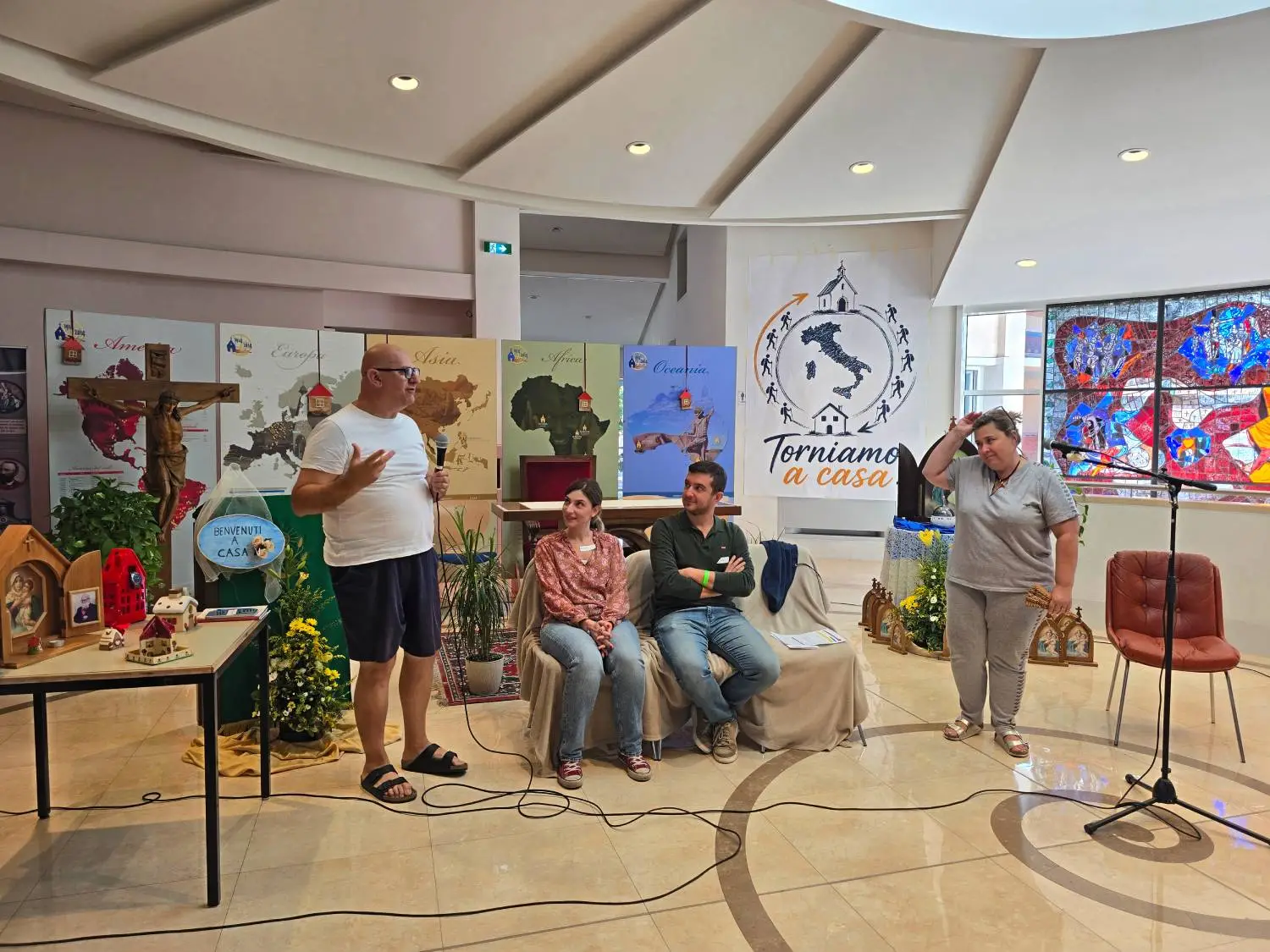
Anna Minici, a young woman from the Movement in Rome, welcomed all the faithful present and offered insights into the skit “The Living Room of ‘Let’s Go Home,’” one of Sunday’s central moments. The skit featured a conversation set in the living room of Paolo Forte and Francesca Molinaro, a couple with children, and included Anna and Giovanni, an engaged couple planning to marry. Through a simple, down-to-earth dialogue, the skit portrayed the experience of the couple who, beginning with their encounter with the Shrine, gradually discovered a new way to live out their family life and mission. All of this stood in contrast to the hopes, expectations, and plans of the engaged couple as they journey toward marriage, guided by the Christian faith.
The central theme of the performance can be summarized in three stages: being welcomed, allowing oneself to be transformed, and becoming an instrument for others. The first stage evoked the grace of home: even before becoming a place to bear witness, the Shrine was, for Paolo and Francesca, a place where they felt welcomed and accompanied in their married life. From there, the dialogue moved on to address the meaning of an “open home” as a place of encounter, listening, prayer, sharing, and hospitality.
The final part highlighted the dimension of apostolic mission. Welcoming, in fact, cannot be limited to the walls of the home: what is received in the Shrine is called to become a gift and a service also outside, in the life of the Movement, in the groups, and in encounters with others. The final message, therefore, is of a faith that springs from the experience of being welcomed, transforms personal and family life, and then leads one to place oneself at the service of others.
A Family That Shares Its Story
One of the defining aspects of the gathering was the exchange about daily life in the various Schoenstatt communities across Italy. In fact, the regions and groups were invited not merely to participate but to become protagonists of the celebration, sharing—through photographs, videos, testimonies, apostolic initiatives, symbols, and meaningful moments—what has developed over the course of the year in their respective communities. The intention is not simply to put on an exhibition, but to allow everyone to get to know more closely the faces, experiences, and fruits of Schoenstatt life in the different regions of Italy.
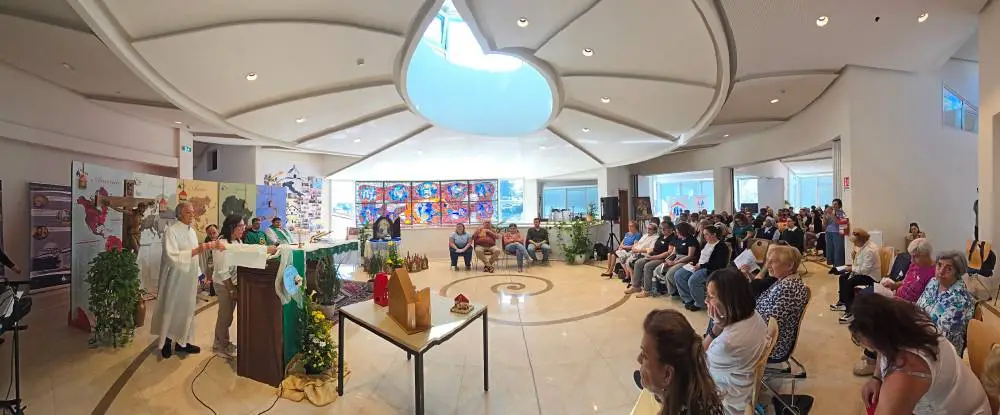
Fr. Pablo Pérez, director of the Schoenstatt Movement in Italy, presided over the day’s meetings and Holy Mass. In his homily, he emphasized that this reflection invites us to read the Gospels as a single narrative of God’s love, which calls each of us to work in His vineyard and, above all, calls for a concrete response in our lives. The son who initially refuses but then changes course becomes an image of authentic conversion, born of sincerity and an encounter with one who knows how to welcome. From this perspective, Mary presents herself at the Shrine as Mother and educator, capable of helping us look deep into our hearts and allowing ourselves to be transformed. True change does not arise from a sense of guilt but from gratitude for what we receive and from the desire to respond to God’s love with our very lives.
Sister M. Julia de Almeida led the pilgrimage activities and shared testimonies from some of the faithful about their spiritual journeys. She introduced Sister M. Cacilda Becker, the new superior of the Institute of the Sisters of Mary at the Cor Ecclesiae Shrine, who spent many years in Schoenstatt, Germany, and most recently served as the international coordinator for the Schoenstatt Movement alongside a priest from the Schoenstatt Fathers. Sister M. Cacilda, like Sister M. Julia, is originally from Brazil. She greeted the faithful in attendance and expressed her joy at working in Italy.
In front of the kiosk where Fr. Kentenich used to pray
The pilgrimage concluded in the early afternoon with a guided tour of the most significant sites at the Belmonte International Center.
First stop: next to the laurel tree (where, in 1965, representatives of the International Schoenstatt Family traveled by car with Fr. Kentenich for a visit and a moment of prayer);
Second stop: the statue of Fr. Kentenich (a work by American sculptor Gwen Gillen, located on the grounds of the Schoenstatt International Center, which arrived directly from Milwaukee (U.S.) to Rome on May 24, 2010);
Third stop: the Shrine (with an explanation of the various symbols and objects);
Fourth stop: the Mother and Queen Chapel (at the old, now-closed entrance to the Belmonte property stands the original Mother and Queen Chapel, where Fr. Kentenich used to stop);
Fifth stop: the House of the Covenant (the Domus Pater Kentenich is a facility for gatherings and retreats and serves as the headquarters of the International Center of the Schoenstatt Institute of Diocesan Priests. Among other features, the house is distinguished by the spiral symbol, present on the floors and in the interior and exterior architectural elements, which symbolizes the faithful’s aspiration toward heaven).
The pilgrims received an invitation that extends beyond Belmonte: returning home does not simply mean rediscovering the Shrine in their homes or in their hearts, but rather means bringing everything they received back to their homes and into their daily lives, so that the Covenant of Love may become a place of welcome, witness, and mission.