
Who today understands the profound meaning of the solemnity of the Immaculate Conception of Mary? And yet, the key lies in understanding the human condition and the fascinating capacity to love that characterizes us. There is much more harmony between “Immaculate” and “loving fully” than one might suppose at first glance.
Mary Immaculate – Icon of what is authentically human
Our humanity is determined by having been created in the image and likeness of God and, therefore, is determined by Love. Hence, we are bodies pierced by souls, and souls that express themselves in bod-ies. Both body and soul were created to love and be loved. But sin has broken our capacity to love fully, which is our deepest purpose.
Living dazed by ideologies that impose a completely different view of humanity, that purpose is forgot-ten. We experience this in our daily lives: our friends, colleagues, even our own children often seem like wanderers in a culture that offers them neither foundation nor support or encouragement in their de-sire to achieve a whole life. The dissolution of family ties, the inability to love, to smile, to trust, to be happy, give credence to these “anthropological heresies,” to use an expression common in Fr. Ken-tenich’s vocabulary.
And yet, in the midst of darkness, redeemed humanity continues to shine. Mary Immaculate is not a reproach to our disoriented vision; she is a constant reminder of the immense greatness that lies dormant within us.
Mary Immaculate is the icon of what is authentically human, of redeemed humanity. Everything in her, her psychological, emotional, and physical structure, is balanced and complemented by grace, which makes her authentically human.
We long for a “spirit of Mary Immaculate”
From a theological point of view, the dogma of the Immaculate Conception refers to Mary’s freedom from original sin in view of Redemption. In other words, when we look at Mary Immaculate, we see what it means to have been redeemed by Christ.
At the time of the Annunciation, Mary is called “full of grace,” which means “filled with God’s love turned toward her.” Does that make her distant or “less human”? Is life in dialogue with God an option-al addition to our humanity? The surprising thing about our human condition is that it necessarily in-cludes grace to become what we are called to be. We will never be perfect on our own, no matter how many self-improvement courses we take. Our true identity, determined by our capacity to love, can only be fully developed if it is healed in Christ.
That is why our human condition longs for Redemption, the harmony that nature radiates when it inter-acts with grace. It longs, even without knowing it, for the “spirit” of true love, more specifically: an “Immaculata Spirit.”
“Immaculata Spirit” – An indispensable part of our charism
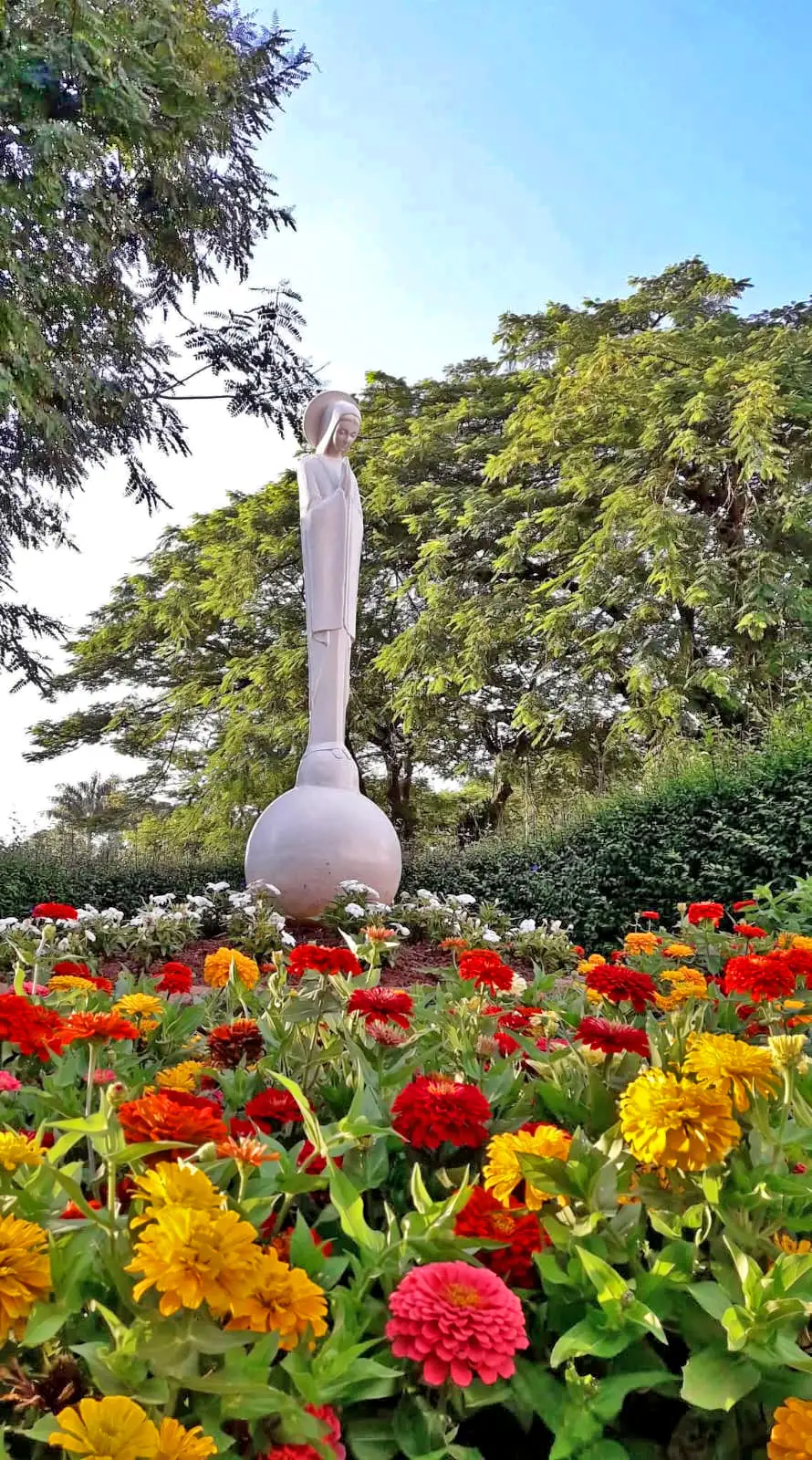
Mary reveals to us what it means to love fully, with our body and soul, each according to our vocation. From the Shrine, she gives us her pedagogical wisdom to help us grow in a purer form of love. Mary embraces my nature as it is, welcoming it with its greatness and vulnerability. She teaches me to “hu-manize” my heart for love: in respect without prejudice for the wounded greatness of the other, in the effort to admire them rather than possess them.
Developing the ability to love in a purer and more detached way is to radiate the “spirit” of the Immacu-lata; it is to create spaces that enable a network of connections in which true love can grow. Mary Im-maculate, the woman of relationships, helps us to restore the order of love in our hearts. This is Schoenstatt’s alternative to anthropological heresies.
This makes our charism more concrete. To illuminate our darkness, we need people who are fascinated by it, in whom the spirit of Mary Immaculate grows through the covenant of love with Mary. The love of Christ, love in its fullness, urges us on (cf. 1 Cor 5:14). There is much more harmony between “Im-maculate” and “love in its fullness” than one might suppose at first glance. Let us ask the Holy Spirit to lead us ever deeper into our charism, so that we may understand and proclaim with even greater depth the relationship between authentic love and the spirit of Immaculata.
Photo: Sr. M. Nilza P. da Silva