60 years ago, a unique moment in Schoenstatt’s history took place: Fr. Joseph Kentenich met with Pope Paul VI after 14 years of exile. This audience was interpreted as a gesture of confirmation and approval of the Founder and the Movement that had arisen from his charism.
December 22, 1965 went down in history as a day of victory after so many struggles, but also as a new beginning in the mission, in which the Movement places itself at the service of the “Church of the new shores.”
Below, we can read a text in which our Father and Founder recounts how this meeting with the Pope went. The text is from January 1966, from a conference for Schoenstatt diocesan priests from the Diocese of Münster.
This is how Fr. Joseph Kentenich recounts it:
I wanted to tell you something about the audience with the Pope. All that I have said until now is only a preparation for this. I had personally intended to apply for a private audience with the Pope, but not immediately, because it would have followed the normal course. For me an audience would only have been meaningful if it was connected with a fundamental discussion. However, all the authorities I have mentioned, and many others, including the Secretary of State, who had banished me and demonized me in the past, were now tremendously keen for me to have an audience with the Pope. I didn’t want it at all and made no effort at all to bring it about. So, it happened without my volition – I will not say that it happened against my will. So, it is obvious that other powers were at work. Human, tangible powers, without doubt, but divine powers were also at work!
They had thought out the following: Because of the situation in Rome they said it was impossible for the Pope to give an audience before 29th December. There were so many Cardinals and bishops who wanted to speak to the Pope before they left for home.
Then, it was the 22nd December, I was told: Audience with the Pope! All the authorities had tried to bring about such an audience. However, the only possibility was that it wasn’t a private audience, but a particular audience. You probably know as little about all these mysteries as I did. It is a world on its own, just as the diplomatic world is a quite different world from the world we know. It is a world with its own laws, emphases and norms.
So, in spite of everything, there was to be an audience on 22nd December. There is a mass audience, a private audience – one is alone with the Pope – and a special audience in which bigger or smaller groups meet the Pope, and then a particular audience. In this instance the only possibility for me was a particular audience.
In the background the Congregation for Religious was thinking: At Christmas we will try to find out how the bishops react if the dove flies over to Germany!
So please note the great benevolence everywhere. It wasn’t as though just any exile or criminal was standing there. The only thing that was possible in the circumstances was a particular audience. At first, I didn’t know what that was, or what would happen. So, I prepared myself to comply with whatever everyone else was doing. We gathered in the audience chamber. I had reckoned that there would be a small number of people present. However, I think that there were about 75 people all told. A particular audience is an audience for men and women who have rendered a service to the Church and deserve to be specially recognized by the Pope. The former “criminal” joined this group!
How was the audience conducted? I don’t want to go into details. I was given a place in the front row. You must picture it to yourselves, the ceremonies are precisely laid down. A place in the front row. Hardly was I standing there than one of the officials came to me and told me to go up after everyone else. So, I had to leave the front row. I sat down again at the side. Hardly had I sat down than one of the monsignori who surround the throne – Monsignor Wuestenberg, whom I knew – greeted me formally and asked me how I was, and similar things. That disrupted the whole ceremonial completely. I told him: I have to go at the end. Yes, he said, because the Pope wants to say something special to you, something private. He then added: Because the Pope doesn’t speak German well, he wants to do it in Latin. It didn’t take long before another gentleman approached me – the one you can see in the photograph. He is Tacoli, the Pope’s valet, who served three Popes and kept each of them informed about us. There were a whole lot of people there, including Nuncio Bafile from here, who did a tremendous lot for us. It is a world in itself. If the machinery of diplomacy had not been strongly employed in the background, it would all have been impossible, humanly speaking. You may not overlook that I never raised a finger in that regard. For that my thinking is too straight. I didn’t prevent it, but I didn’t promote it either.
Then things took their course, very simply and quite differently from what I had imagined. The individuals approached the throne, knelt down, kissed the Pope’s ring and received his blessing, and moved on. It did happen that a number of people formed a small group – obviously a Dominican community of four or six people – and they knelt down together. This then took a little time. The Pope said a word here or there. It all happened very quickly: one, two, three, smile here and there, receive the blessing, again a smile in this or that direction, then that was the end of it. That was the solemn recognition given for services to the Church.
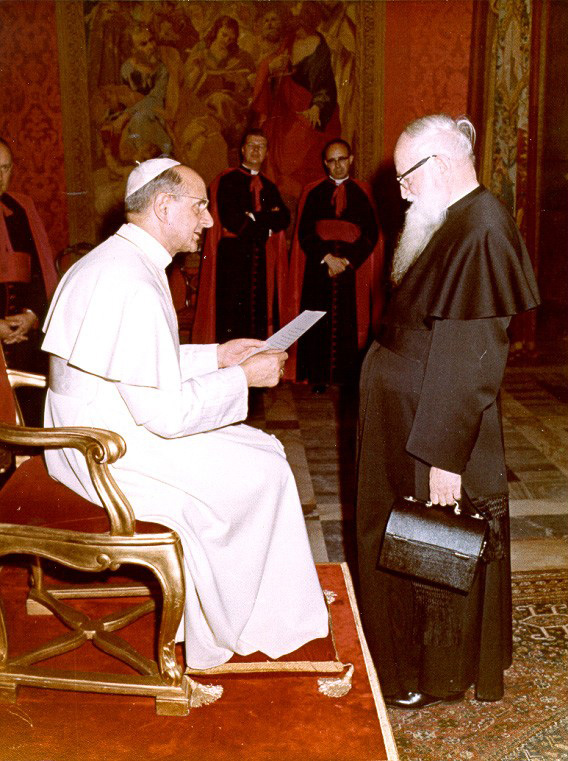
They all left the room. At the end I was completely on my own in the middle of the large hall. The Pope sat there, and around him stood his entourage who were present partly to translate if necessary, and partly to increase the solemnity of the occasion. I knelt, kissed the Pope’s ring, then I stood there – you probably remember it from the photo – with a little box in my hand. You can see it in the photo. I wasn’t very bent, nor was I very worn out, but just the way I am, unabashed. The photo is particularly significant, because it was not an official one. As far as I know, the Pope usually poses as does the other person. So, the photo was taken quite off the cuff.
I like the photo, if you really look at it. If you know the background, it is in truth a very original ending to a tremendously powerful, tense and dangerous time of battle.
Allow me to point out once again how much people prayed in the course of the years for the Pope to be given “the Schoenstatt vision” – it is a technical expression (260). He was! The audience is in fact the answer to countless prayers in the course of the decades.
The Pope then asked me in a very friendly way, “Which language?” Answer, “In Latin.” Firstly, I had prepared myself for that, and secondly, it was natural, because he found it difficult to speak German. However, I did not know what was to follow. He turned round and was given a relatively long sheet of paper. In German! You can see it in the photo. He read it out very solemnly, as though it was an encyclical. I stood there and listened quietly. However, if I had to repeat it to you, I would be able to say very little. Do you know why? It was one long eulogy. You can imagine how little I am moved by a eulogy today. Nevertheless, I became aware that it was more than the usual eulogy. In the context, where everything is so very official, and where everything is considered any number of times, it was in fact a very unusual legitimization and reinstatement.
He finished reading and I answered in Latin. Essentially there were three thoughts:
Firstly, on behalf of Schoenstatt I wanted to thank most sincerely for what had been done so abundantly for Schoenstatt during his reign, and especially that he had reinstated me. So it was clearly put. I must also admit, I would never have accepted an amnesty. Please forgive me if I put it so bluntly. The good name of the Family demanded it. It had nothing to do with an amnesty. It had to be an official and juridical act of reinstatement.
Once the problems had been solved in such a way, and once Cardinal Ottaviani was the first to congratulate me on my birthday by sending me a telegramme – just imagine that! – it never occurred to me to visit him in return. I merely thanked him in writing. Can you understand why? I also never gave him a gift. In every other instance I am passionately “weak” in this regard. So, if you want something like that from me and I have it, you can have everything I have got. The only thing is, you may not demand it as a right, because then you won’t get a penny from me. That is my principle; I never did it, although I gave other men something out of gratitude, because they had involved themselves in my reinstatement. Later, after the Cardinal had admitted solemnly to Tacoli – something really lovely – that he was genuinely sorry that, without having personally stained his conscience in a subjective sense, he had been the instrument that had done such dreadful injustice to me for years, I would have been able to visit him. However, the case is closed. There is such a thing as a sound sense of justice. You aren’t there just as an individual, you are there as a representative of the Family.
Secondly, I promised the Pope on behalf of the Family that together with the Family I would do all in my power to ensure that the post – conciliar mission of the Church would be carried out as perfectly as possible. Then a discussion started. That is to say, I had deliberately added, sub tutela matris ecclesiae – under the protection of the Blessed Mother as Mother of the Church. This is obviously his favourite idea. He remarked, “Yes, matre ecclesia.” (261) “No,” I said, “oh no! I said, sub tutela matri ecclesiae!” He replied, “You are right”.
Thirdly, to confirm and perpetuate this promise I wanted to bring him this chalice – you know the chalice – as a gift for the new church that is being planned under the title Matri ecclesiae. I then added, a matre ecclesiae, in matre ecclesiae and pro matre ecclesiae. (262)
This did not bring the audience to a close. So, you can see, compared with everything else that had happened, it was quite unusual. As I presented the chalice – you can see how the Monisgnori around him were in a hurry to see it. Naturally I took this at first as a diplomatic gesture, but within the framework of the whole event it still has a profound meaning. He began to speak very quietly and remarked that I knew Bishop Manziana. He was a friend, an Italian, who was in Dachau. I had saved his life at that time. When I returned home from Dachau and planned my world trips, it was impossible for a German at that time to leave Germany. At the time Manziana had got me a Vatican diplomatic passport from Montini, later Paul VI, so that I could travel round the world.
“Yes,” I replied, “I know him well”. “And”, the Pope went on, “he spoke in such high terms of praise about you.” He related it in detail. Then the audience came to an end.
I was ushered out as the last. Outside many people were waiting for me.
That was on 22nd December. On 23rd December Cardinal Antoniutti had a private audience with the Pope. He returned, called me on the phone – in a very friendly way, so not through intermediaries, but personally – and told me that he had had an audience with the Pope and I should listen carefully: the Pope gave me permission to return to Germany. The only restriction, which had only been made for tactical reasons, was thus removed by virtue of the direct power of the Pope. So, I was able to travel, but I was to remain dependent on the Bishop of Münster. That again was a normal diplomatic move. They wanted to shift the responsibility to some other authority. So, I should do my business in dependence on the Bishop of Münster. I could also return to Rome. Since I do not want to have much to do with diplomatic matters, I quickly asked: How is that meant? “Can” or “should”? At the same moment I recalled: You have to talk diplomatically; and then I said, because he did not understand me immediately, yes, I will return a week after Christmas, that is, after the feast of Epiphany.
That was the end of the matter.
Do you now know everything? It was only meant as a small relaxation for you, otherwise I would have described it far more systematically.